

AI agent companies are changing how enterprises manage daily work. Instead of only using simple chatbots, companies now use enterprise AI agents that can understand tasks, connect with business systems, follow workflows, and help teams complete work faster.
For enterprise workflow automation, this matters a lot. Businesses deal with customer support tickets, HR requests, finance approvals, sales follow-ups, IT service tasks, document processing, and internal reporting every day. A custom AI agent can help automate these tasks while keeping human control where needed.
This guide by Tach Specs covers the top 10 AI agent companies for enterprise workflow automation, focusing on platforms that help businesses build, deploy, govern, and scale AI agent tools.
Why AI Agent Companies Matter for Enterprise Workflow Automation
Enterprise workflow automation is no longer just about rule-based automation. Traditional automation follows fixed steps, but enterprise AI agents can understand context, make decisions within rules, use business data, and trigger actions across different systems.
That is why companies are looking for an AI agent platform that can support:
- Custom AI agent creation
- Business app integrations
- Workflow orchestration
- Governance and security
- Human-in-the-loop approval
- Scalable enterprise deployment
- Reporting and monitoring
The best AI agent companies do not only provide AI chat. They provide AI agent tools that connect people, data, applications, and automated actions.
1. Microsoft Copilot Studio
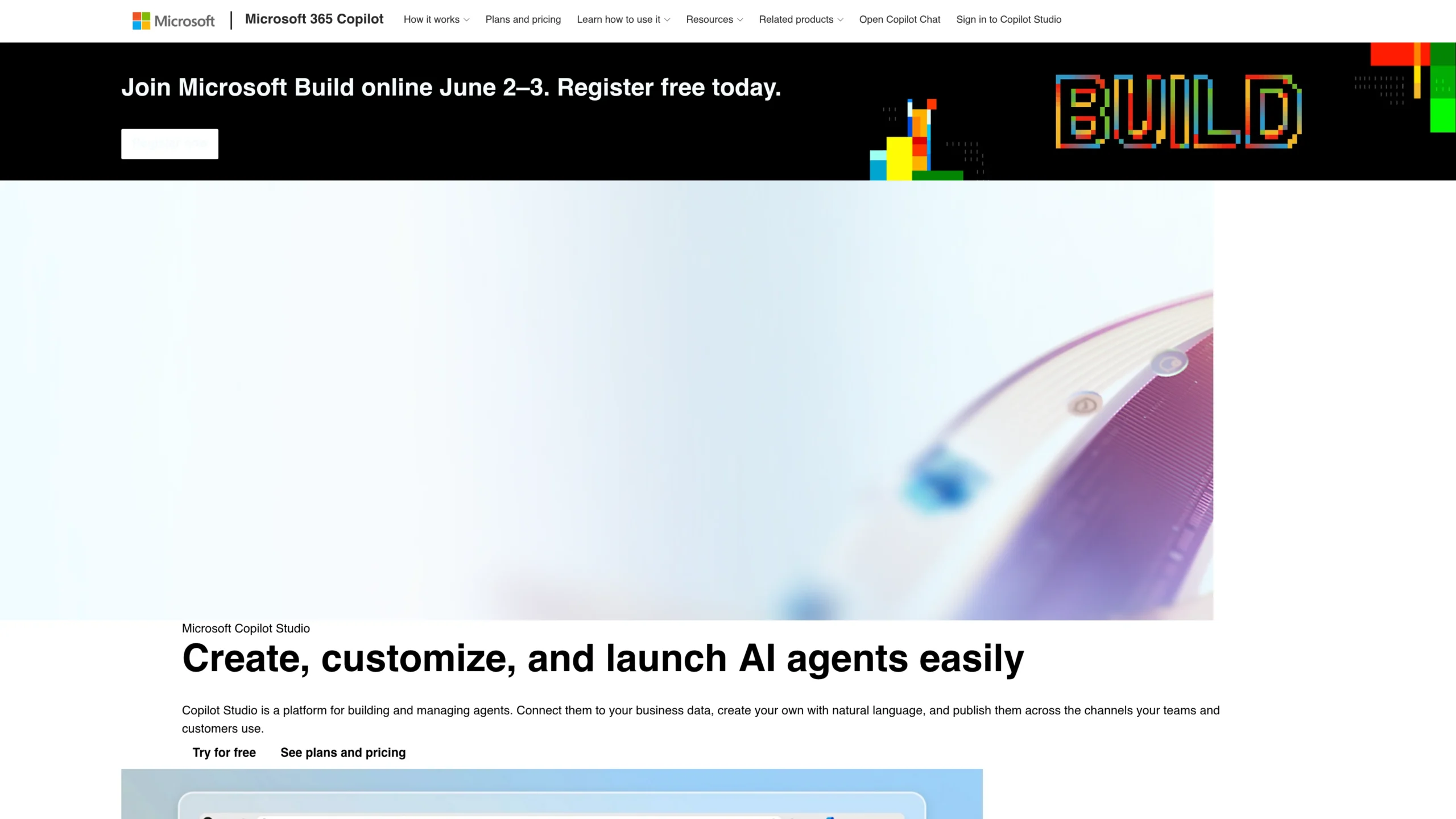
Microsoft Copilot Studio is one of the strongest AI agent companies for enterprises already using Microsoft 365, Teams, SharePoint, Dynamics, and Power Platform. It allows businesses to create agents using natural language or graphical tools and publish them across Microsoft environments.
It is a practical choice for enterprise workflow automation because many employees already work inside Microsoft tools. A custom AI agent built with Copilot Studio can support internal helpdesk tasks, HR FAQs, sales support, knowledge search, and employee productivity workflows.
Features:
- Low-code agent builder
- Natural language agent creation
- Microsoft 365 Copilot integration
- Prebuilt and custom connectors
- Agent flows for business logic
- Enterprise security and governance
Free/Starter Features:
- Free trial options may be available
- Basic agent exploration
- Microsoft learning resources
- Readiness assessment resources
Pro/Enterprise Features:
- Publish agents to Microsoft 365 Copilot
- Advanced connectors
- Enterprise data integration
- Governance and admin controls
- Pay-as-you-go or licensed usage options
Best For:
Enterprises using Microsoft 365, Teams, SharePoint, Dynamics, and Power Platform.
Limitations:
- Best value comes inside the Microsoft ecosystem
- Advanced workflows may still need technical setup
- Licensing can be complex for large teams
Best Use Cases:
- Employee support agents
- HR and IT helpdesk automation
- Internal knowledge assistants
- Microsoft 365 workflow automation
- Department-specific custom AI agent projects
2. OpenAI AgentKit
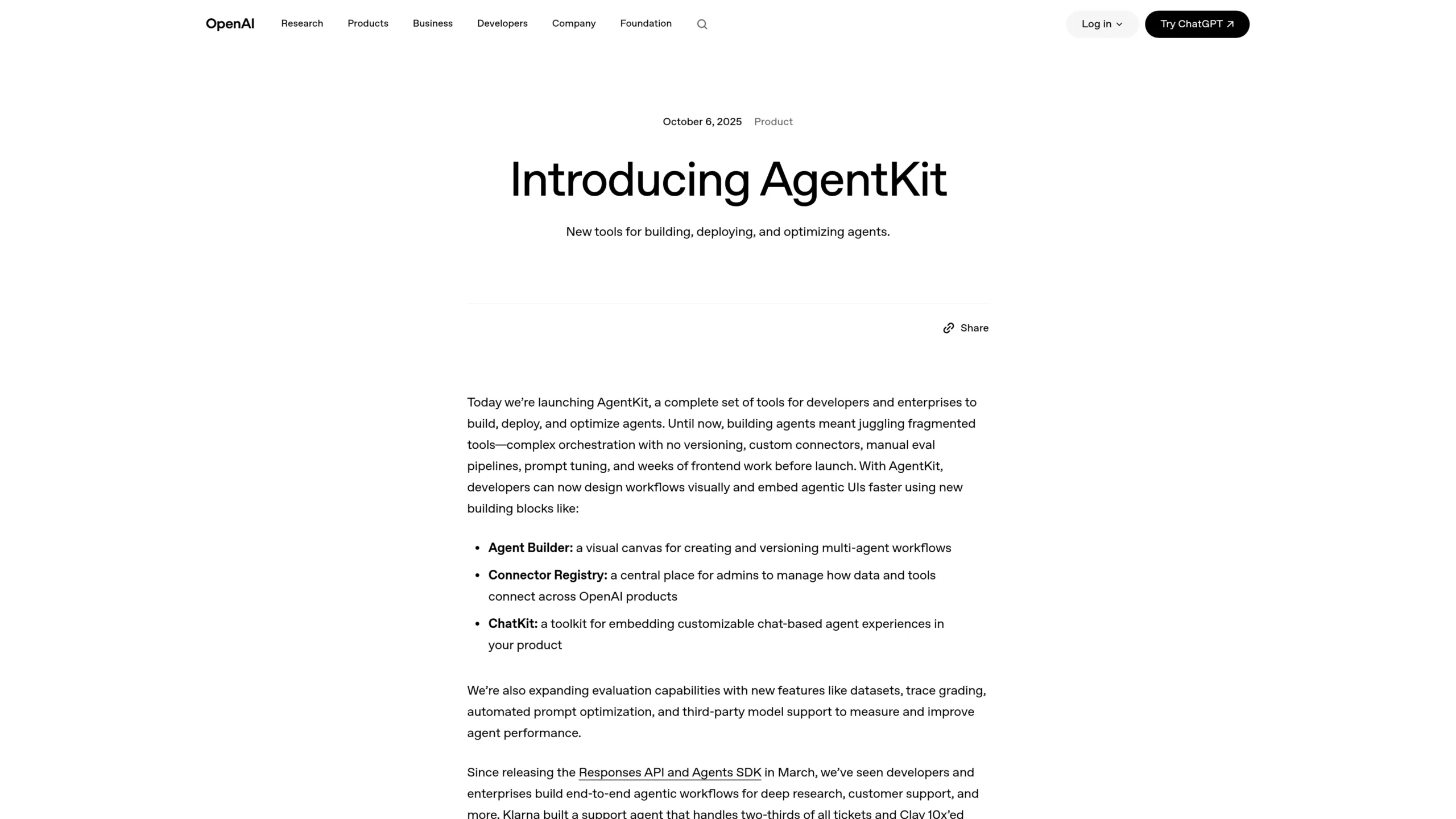
OpenAI is one of the most important AI agent companies because its models and agent tools are widely used for building custom AI agent systems. AgentKit is designed to help developers and enterprises build, deploy, and optimize agents, while Agent Builder provides a visual workflow canvas for building agentic workflows.
For enterprise workflow automation, OpenAI is especially useful when a company wants flexible AI agent tools for custom workflows, customer-facing assistants, internal copilots, research agents, and multi-step task automation.
Features:
- Agent Builder visual workflow canvas
- Strong language model capability
- Multi-step agent workflow support
- Evaluation and optimization tools
- Flexible API-based development
- Custom AI agent experiences
Free/Starter Features:
- Developer documentation
- Example workflows
- Prototyping support
- GPT creation options for simpler use cases
Pro/Enterprise Features:
- Enterprise-grade agent development
- API-based integration
- Custom workflow design
- Evaluation and testing
- Advanced deployment options
Best For:
Companies that want flexible, high-quality AI agent model development.
Limitations:
- More technical than some no-code tools
- Production deployment needs planning
- Custom integrations may need developers
Best Use Cases:
- Custom AI agent platforms
- Internal research agents
- AI-powered customer support
- Multi-step business automation
- Agentic workflow prototypes
3. Google Gemini Enterprise Agent Platform
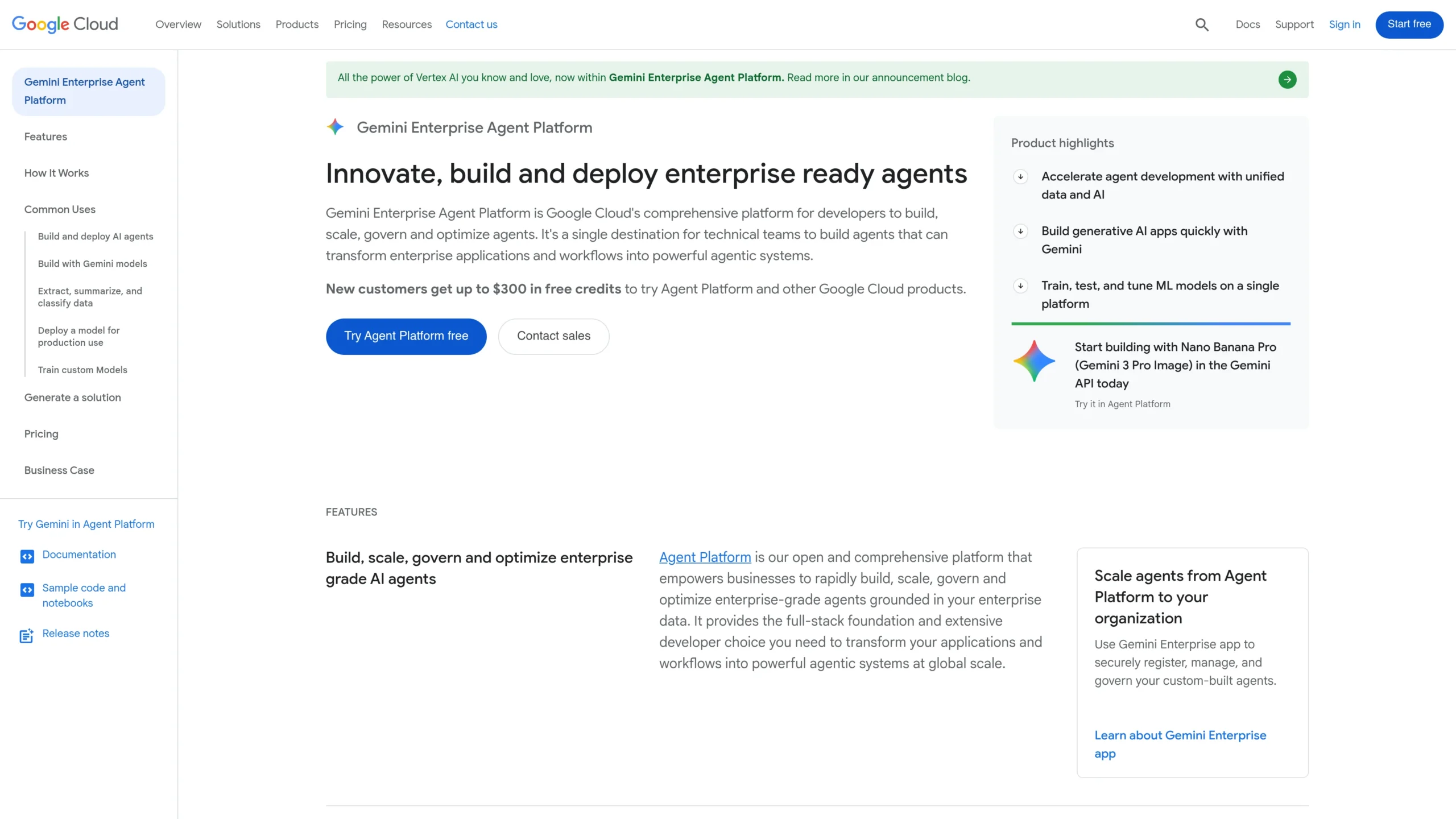
Google Gemini Enterprise Agent Platform is built for enterprises that need to build, deploy, govern, and optimize enterprise-ready agents in one platform. Google describes it as a unified platform for enterprise-grade AI agents and model-based solutions.
It is a strong AI agent platform for organizations already using Google Cloud, Google Workspace, cloud data systems, and machine learning infrastructure. For enterprise workflow automation, it supports technical teams that need scale, governance, model choice, and agent lifecycle management.
Features:
- Enterprise agent building
- Agent deployment and governance
- Model access and optimization
- Google Cloud integration
- Agent lifecycle support
- Security and monitoring tools
Free/Starter Features:
- Google Cloud trial credits may be available
- Documentation and codelabs
- Starter agent experiments
- Gemini model exploration
Pro/Enterprise Features:
- Enterprise-grade agent deployment
- Agent governance
- Model tuning and evaluation
- Cloud-native security
- Integration with Google Cloud services
Best For:
Enterprises using Google Cloud, Gemini, BigQuery, Workspace, and cloud AI infrastructure.
Limitations:
- Best for teams with Google Cloud knowledge
- Setup can be technical
- May be more complex for small businesses
Best Use Cases:
- Cloud-based enterprise AI agents
- Data-driven workflow automation
- Internal business assistants
- AI agents connected to Google Workspace
- Large-scale agent governance
4. Salesforce Agentforce
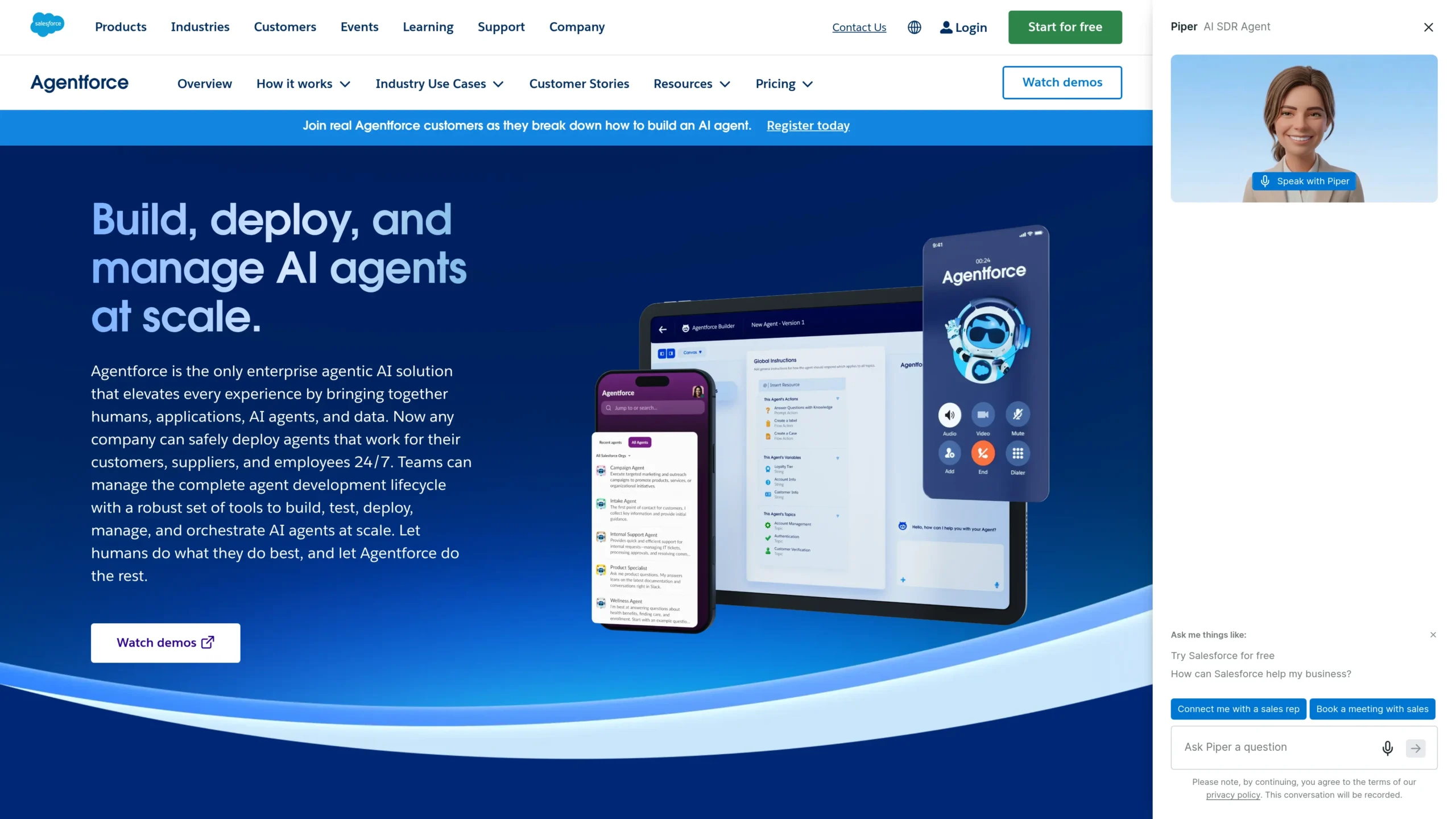
Salesforce Agentforce is a major AI agent platform for sales, service, marketing, commerce, and CRM workflows. Salesforce describes Agentforce as a platform for building and customizing autonomous AI agents that support employees and customers 24/7 inside the Salesforce ecosystem.
For enterprise workflow automation, Agentforce is especially useful when customer data, sales pipelines, service tickets, and marketing actions already live inside Salesforce.
Features:
- Autonomous CRM agents
- Customer and employee support
- Salesforce data integration
- Role-based AI agents
- Business knowledge grounding
- Action planning and execution
Free/Starter Features:
- Product demos and learning resources
- Salesforce trial environments may vary
- Agentforce educational resources
Pro/Enterprise Features:
- CRM workflow automation
- Data Cloud integration
- Sales and service agents
- Enterprise security controls
- 24/7 customer and employee support agents
Best For:
Salesforce customers that want enterprise AI agents for CRM automation.
Limitations:
- Best suited for Salesforce-heavy businesses
- Pricing and setup may be enterprise-focused
- Customization may require Salesforce expertise
Best Use Cases:
- Sales automation
- Customer service agents
- Lead qualification
- CRM data updates
- Marketing and commerce workflows
5. ServiceNow AI Agents
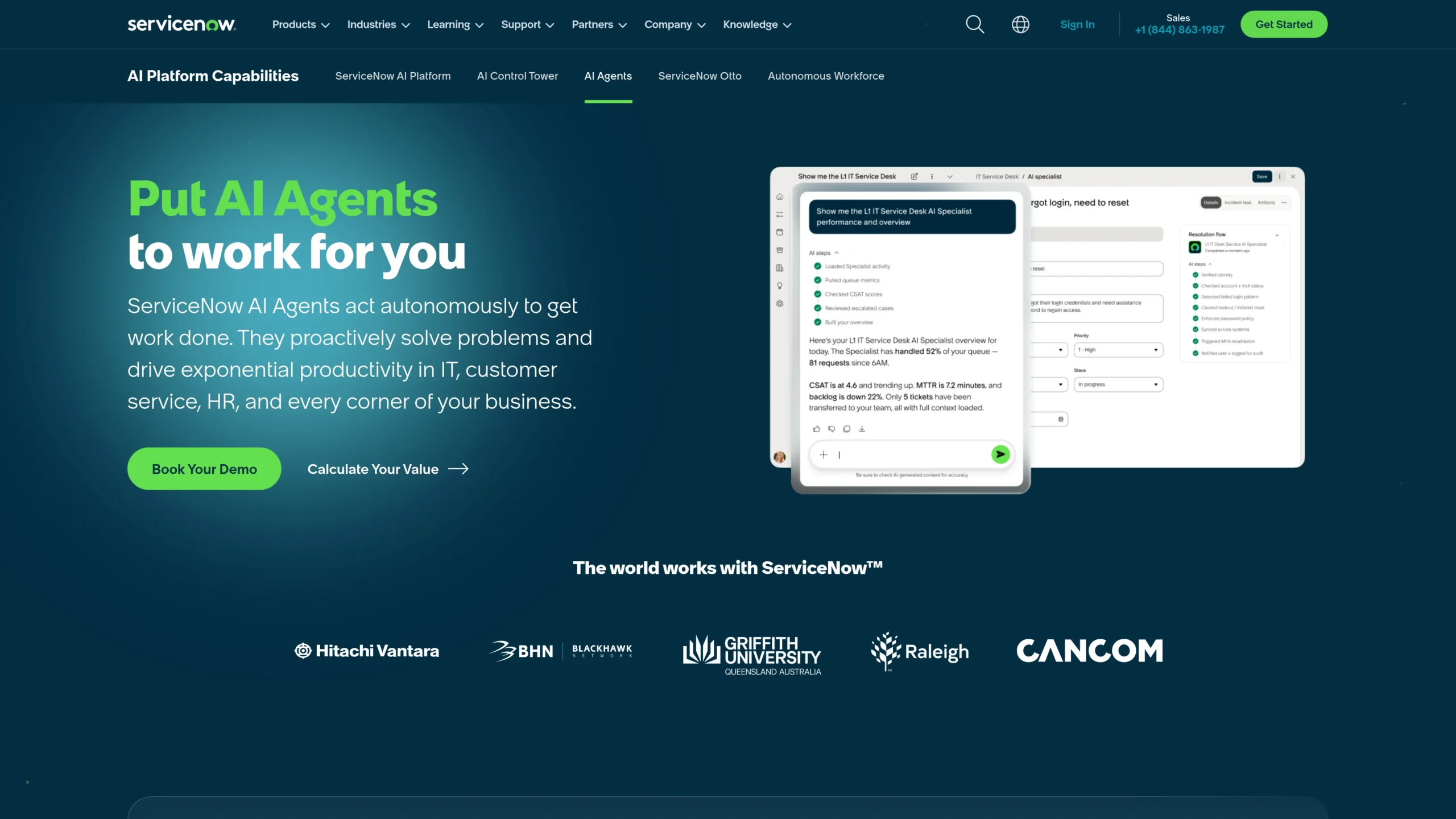
ServiceNow is one of the best AI agent companies for IT, HR, customer service, and enterprise service management. ServiceNow positions its AI platform around streamlining enterprise workflows for both employees and customers.
For enterprise workflow automation, ServiceNow AI Agents are useful because many companies already use ServiceNow for ITSM, HRSD, CSM, and operational workflows.
Features:
- Enterprise service workflow automation
- AI agents for business productivity
- IT, HR, and customer service support
- Workflow intelligence
- Enterprise platform integration
- Governance and service management support
Free/Starter Features:
- Product demos
- Educational resources
- Use-case discovery materials
Pro/Enterprise Features:
- AI agents inside ServiceNow workflows
- Enterprise workflow orchestration
- IT and HR automation
- Customer service management
- Platform-level governance
Best For:
Large enterprises using ServiceNow for service management and workflow operations.
Limitations:
- Best value comes for existing ServiceNow users
- May require implementation support
- Not ideal for simple small-business automation
Best Use Cases:
- IT ticket resolution
- HR service requests
- Customer service workflows
- Enterprise service operations
- Internal support automation
6. Amazon Bedrock Agents
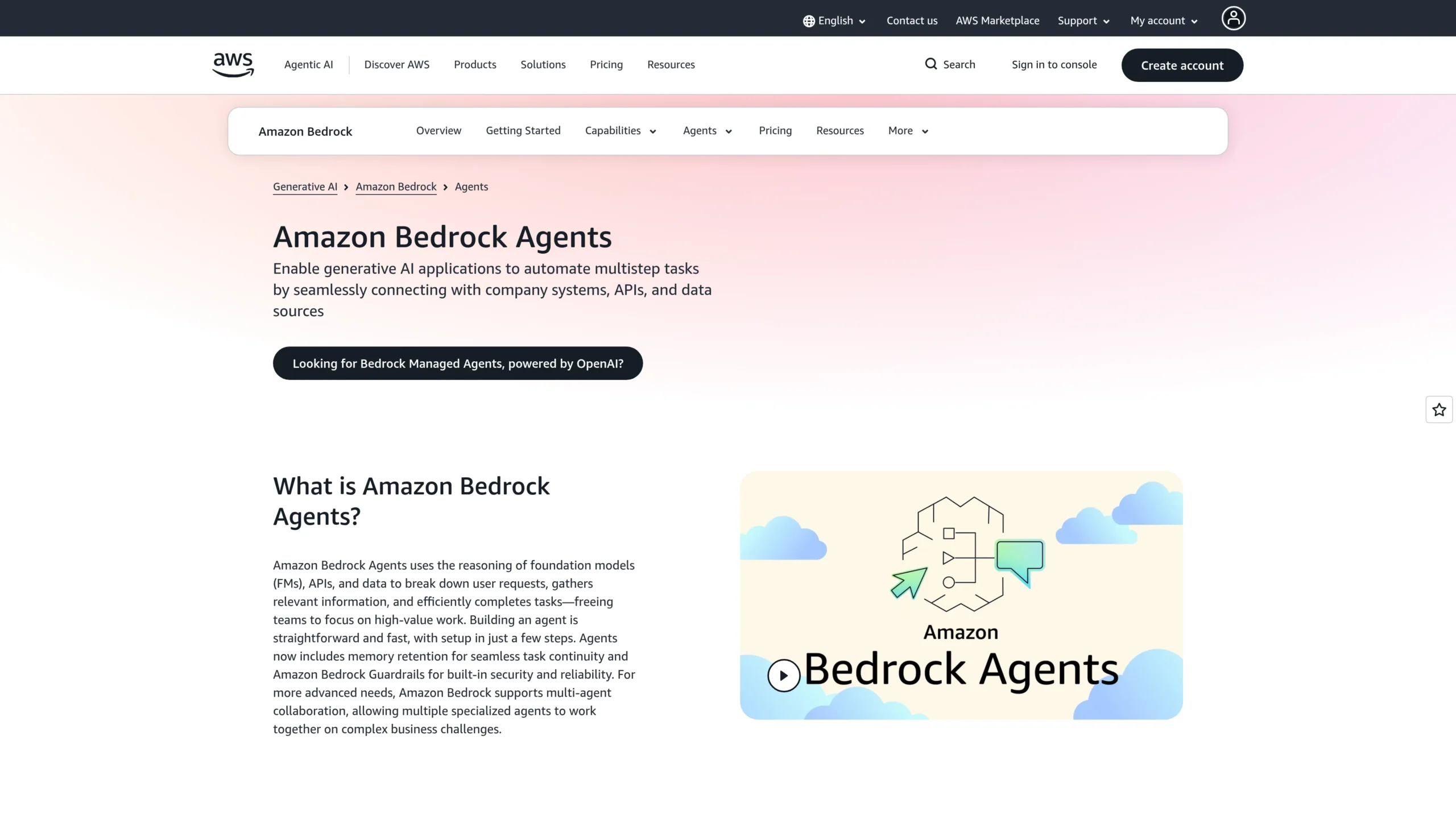
Amazon Bedrock Agents help businesses build generative AI applications that automate multistep tasks by connecting with company systems, APIs, and data sources. Amazon Bedrock AgentCore also supports building, deploying, and operating agents securely at scale.
For enterprise workflow automation, AWS is a strong choice for companies already running data, applications, and infrastructure on AWS.
Features:
- Multistep task automation
- API and data source connection
- Secure agent deployment
- Model flexibility through Bedrock
- AgentCore for production operations
- Scalable AWS infrastructure
Free/Starter Features:
- AWS documentation
- Starter examples
- Free tier or credits may vary
- Prototype agent development
Pro/Enterprise Features:
- Production-grade agent security
- Enterprise data connection
- Model and framework flexibility
- Monitoring and scaling
- Advanced AWS integration
Best For:
Enterprises already using AWS cloud infrastructure.
Limitations:
- More technical than no-code platforms
- Best for cloud and developer teams
- Requires AWS architecture knowledge
Best Use Cases:
- Cloud-native AI agents
- API-connected workflow automation
- Data-driven enterprise agents
- Secure internal automation
- AI agents for SaaS and backend systems
7. UiPath
UiPath is a strong AI agent company for enterprises that already use robotic process automation. Its Agentic Automation Platform includes Agent Builder and UiPath Maestro, which bring together AI agents, robots, tools, AI models, and people for end-to-end processes.
For enterprise workflow automation, UiPath is useful when businesses need AI agents to work with existing RPA bots, legacy systems, documents, and human approval steps.
Features:
- Agent Builder
- UiPath Maestro orchestration
- RPA and AI agent combination
- Human-in-the-loop support
- Enterprise process automation
- Prebuilt and custom agent options
Free/Starter Features:
- Trial access may be available
- Learning resources
- Community support
- Starter automation tools
Pro/Enterprise Features:
- Enterprise agent deployment
- Advanced RPA integration
- Process orchestration
- Governance and monitoring
- Business-critical workflow automation
Best For:
Enterprises using RPA or looking to combine AI agents with automation robots.
Limitations:
- Can require automation expertise
- Enterprise implementation may take time
- Best for process-heavy organizations
Best Use Cases:
- Finance process automation
- Invoice dispute resolution
- Legacy system automation
- Document-heavy workflows
- End-to-end process orchestration
8. Automation Anywhere
Automation Anywhere focuses on agentic process automation. Its system combines goal-driven AI agents with automation tools, governance, enterprise context, RPA, APIs, and process orchestration for end-to-end workflows.
It is one of the top AI agent companies for enterprises that want to move from traditional RPA to enterprise AI agents that can support complex business processes.
Features:
- Agentic Process Automation
- Goal-driven AI agents
- RPA and API automation
- Process orchestration
- Enterprise governance
- Prebuilt AI agents
Free/Starter Features:
- Product learning resources
- Demos and trial options may vary
- Starter automation exploration
Pro/Enterprise Features:
- Enterprise-grade process automation
- Prebuilt agentic solutions
- Governance and security
- Complex workflow orchestration
- Automation across apps and teams
Best For:
Companies that want AI agent tools combined with RPA and process automation.
Limitations:
- May require process mapping
- Best for mature automation teams
- Enterprise setup can be complex
Best Use Cases:
- Finance automation
- Operations automation
- Document processing
- Back-office workflows
- Cross-application business processes
9. Workato
Workato is a leading enterprise workflow automation and integration platform that is moving strongly into agentic AI. Workato says its agentic tools help businesses build and manage AI agents code-free, connect systems, follow rules, and orchestrate workflows.
For enterprise workflow automation, Workato is a great fit when businesses need agents to work across many SaaS tools, CRMs, support platforms, finance systems, and internal applications.
Features:
- Code-free AI agent building
- Enterprise MCP support
- 1,400+ app connections
- Workflow orchestration
- Business rule control
- Cross-system automation
Free/Starter Features:
- Trial options may be available
- Product demos
- Workflow templates
- Learning resources
Pro/Enterprise Features:
- Enterprise orchestration
- App and system integrations
- Agentic AI workflow management
- Security and governance
- Advanced automation recipes
Best For:
Enterprises that need AI agents connected across many business apps.
Limitations:
- Best for companies with many SaaS systems
- Complex workflows may need planning
- Advanced governance is enterprise-focused
Best Use Cases:
- SaaS workflow automation
- Sales operations
- Finance operations
- HR automation
- Multi-app enterprise workflows
10. n8n
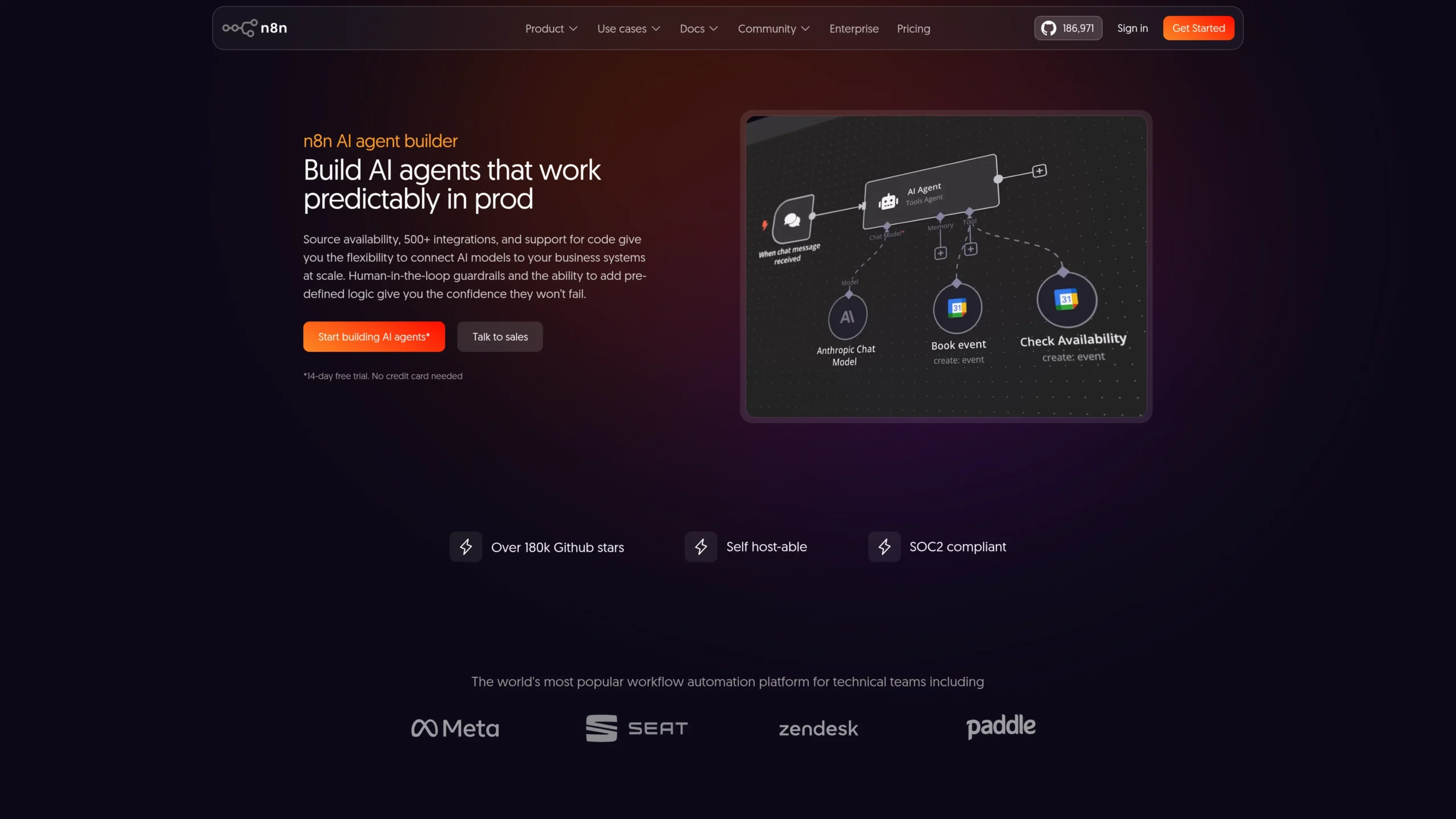
n8n is a flexible AI workflow automation platform for technical teams and automation-focused businesses. Its AI agent builder supports source availability, 500+ integrations, human-in-the-loop guardrails, and visible workflow logic.
For enterprise workflow automation, n8n is useful for teams that want more control over AI agents, integrations, self-hosting, and visual workflows.
Features:
- Visual workflow builder
- AI agent automation
- 500+ integrations
- Self-hosting option
- Human-in-the-loop controls
- Code and no-code flexibility
Free/Starter Features:
- Community and self-hosting options
- Trial access
- Templates and documentation
- Visual workflow testing
Pro/Enterprise Features:
- Enterprise deployment
- Advanced workflow management
- Team collaboration
- Security controls
- Scalable automation support
Best For:
Technical teams, startups, agencies, and businesses that want flexible AI agent tools.
Limitations:
- More technical than simple no-code tools
- Enterprise governance depends on the setup
- Best results require workflow knowledge
Best Use Cases:
- Custom AI agent workflows
- Internal automation
- API-connected AI agents
- Startup operations
- Agency automation systems
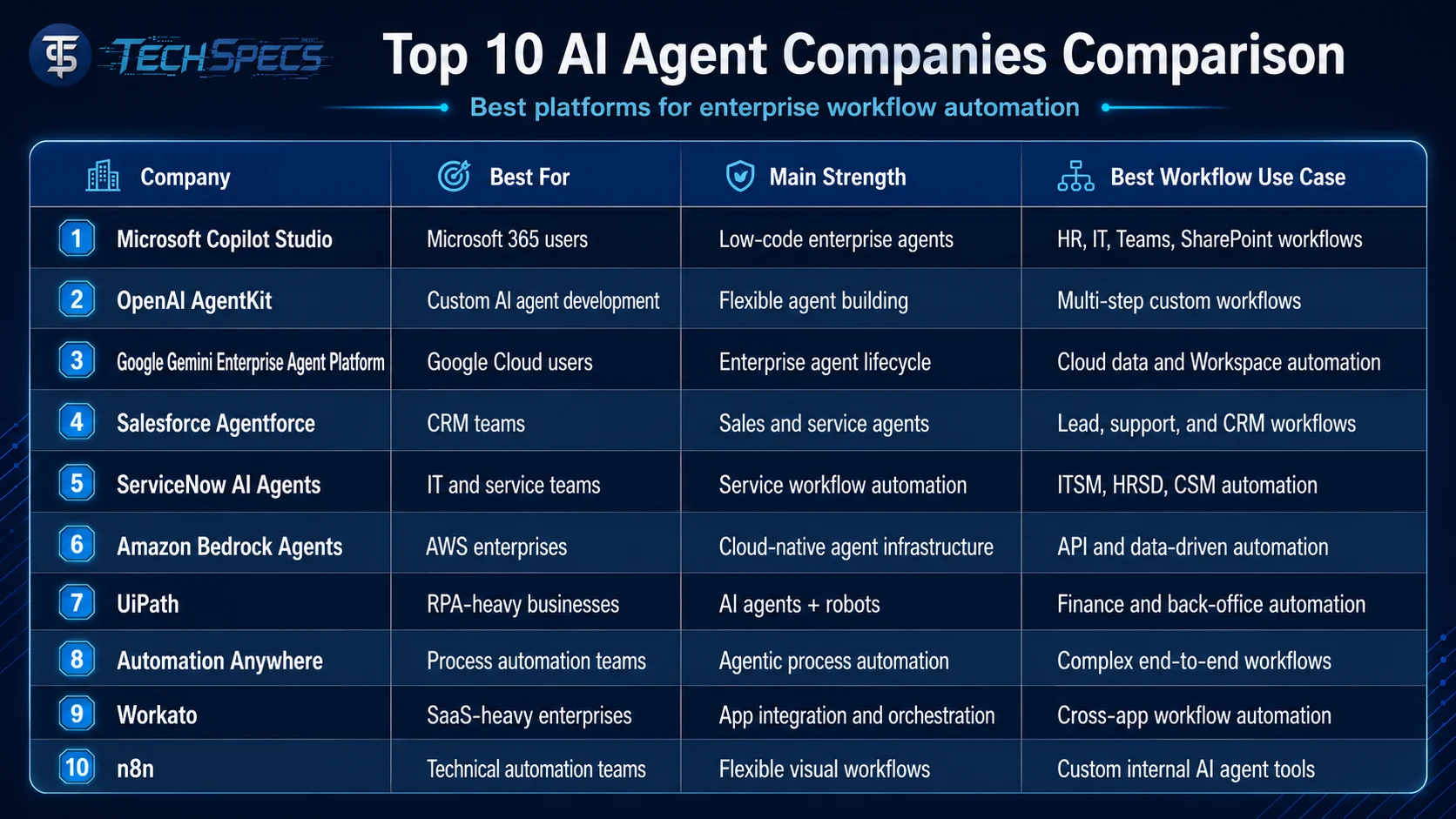
Top 10 AI Agent Companies Comparison
Best AI Agent Companies by Use Case
Best for Microsoft-based enterprises:
Microsoft Copilot Studio
Best for custom AI agent development:
OpenAI AgentKit
Best for Google Cloud and AI lifecycle management:
Google Gemini Enterprise Agent Platform
Best for CRM automation:
Salesforce Agentforce
Best for IT and service workflow automation:
ServiceNow AI Agents
Best for AWS cloud-native agents:
Amazon Bedrock Agents
Best for RPA and business process automation:
UiPath
Best for agentic process automation:
Automation Anywhere
Best for SaaS app orchestration:
Workato
Best for flexible and technical AI workflows:
n8n
Recommendation
For most large enterprises, the best AI agent company depends on the tools the business already uses.
Choose Microsoft Copilot Studio if your team works heavily in Microsoft 365. Choose Salesforce Agentforce if your main workflows are inside CRM. Choose ServiceNow AI Agents if IT, HR, and service management are your biggest automation needs. Choose AWS Bedrock Agents or Google Gemini Enterprise Agent Platform if your business needs cloud-native AI agent infrastructure.
For companies focused on process automation, UiPath and Automation Anywhere are strong choices. For app-to-app enterprise workflow automation, Workato is excellent. For teams that want flexible and visible AI agent tools, n8n is a practical option.
The best strategy is to start with one custom AI agent for one business workflow, test it carefully, add human approval where needed, and then scale it across departments.
Final Thoughts
AI agent companies are becoming essential for enterprise workflow automation. The best platforms help businesses go beyond simple chatbots and create enterprise AI agents that can understand tasks, connect data, trigger actions, and support real business outcomes.
A strong AI agent platform should not only be powerful. It should also be secure, governed, easy to monitor, and connected to the systems your company already uses.
For businesses planning to adopt AI agent tools, the goal should be simple: start small, automate one valuable workflow, measure the result, and then expand with better governance and stronger custom AI agent design.
FAQs
1. What are AI agent companies?
AI agent companies build platforms and tools that help businesses create AI agents for tasks like customer support, workflow automation, sales, HR, IT, finance, and internal operations.
2. What is enterprise workflow automation?
Enterprise workflow automation means using software to automate business processes across departments, systems, and teams. With AI agents, this can include reasoning, decision support, and action-taking.
3. Which AI agent company is best for Microsoft users?
Microsoft Copilot Studio is usually the best fit for Microsoft users because it connects with Microsoft 365, Teams, SharePoint, and other Microsoft tools.
4. Which AI agent platform is best for CRM automation?
Salesforce Agentforce is a strong option for CRM automation because it works inside the Salesforce ecosystem and supports sales, service, and customer workflows.
5. Which AI agent tools are best for RPA?
UiPath and Automation Anywhere are strong choices for businesses that want AI agents combined with robotic process automation.
6. Can non-developers build a custom AI agent?
Yes. Platforms like Microsoft Copilot Studio, Workato, Salesforce Agentforce, and some n8n workflows can help non-developers or low-code users build custom AI agents.
7. Are enterprise AI agents better than chatbots?
Enterprise AI agents are usually more advanced than basic chatbots because they can connect to systems, use business data, follow workflows, and take actions with proper rules.
8. What is the best AI agent company for cloud-native development?
AWS Bedrock Agents and Google Gemini Enterprise Agent Platform are strong choices for cloud-native AI agent development.
9. What should a company check before choosing an AI agent platform?
A company should check integrations, security, governance, pricing, workflow support, scalability, human approval options, and compatibility with existing systems.
10. Can AI agents automate finance workflows?
Yes. AI agents can help with invoice processing, reporting, approvals, reconciliation support, and finance document workflows when properly connected and governed.
11. Are AI agent tools safe for enterprises?
They can be safe when companies use access control, audit logs, data governance, testing, human approval, and clear limits on what agents can do.
12. What is the easiest way to start with enterprise AI agents?
Start with one simple workflow, such as HR FAQs, IT ticket routing, sales follow-up, or customer support triage. Then test, improve, and scale carefully.