

You pick up the phone. A caller sounds exactly like your most trusted client. They confirm the account number, pass your security check, and request a large wire transfer. Every single thing sounds legitimate.
Except it is not.
The voice was cloned from a 45-second audio clip taken from a podcast. The caller was an AI bot. And by the time your team realizes something went wrong, the money is already gone.
This is not a worst-case scenario for the future. This is what is happening in contact centers right now, today, in 2026. And if your business is still relying on passwords, knowledge-based authentication, or SMS two-factor codes to stop it, you are fighting a machine-speed war with human-speed tools.
That is exactly the gap that agentic AI Pindrop Anonybit was built to close.
In this guide, you will get a complete, practical breakdown of how the agentic AI Pindrop Anonybit framework works, why it outperforms every traditional security approach, and what real deployments are actually achieving. Whether you are a CISO, a fraud operations leader, or a business executive trying to understand what your security team should be doing right now, this is what you need to know.
Why 2026 Is a Different Kind of Threat Environment
Let us start with the numbers, because they tell a story that is hard to ignore.
According to Pindrop’s 2025 Voice Intelligence and Security Report, contact centers logged an estimated 2.6 million fraud incidents in 2024, resulting in roughly $12.5 billion in losses. That same report projects a 162% increase in deepfake fraud, a trajectory that has not slowed entering 2026. AI-driven fraud surged 1,210% in 2025, significantly outpacing traditional fraud growth, with synthetic audio emerging as the dominant threat vector across contact centers and high-value enterprise workflows.
But the raw numbers do not capture the full picture. What has changed is not just the volume of attacks. It is their nature.
A few years ago, voice fraud meant a human criminal calling your contact center and pretending to be someone else. They might slip up. A well-trained agent could sometimes catch it. Today’s fraudsters do not slip up. They use the same AI-powered fraud prevention technology in reverse, weaponizing it to create undetectable attacks. With commercially available voice cloning tools, a criminal can build a near-perfect synthetic replica of your customer’s voice from just three seconds of publicly available audio.
Then they hand that clone to an autonomous AI agent.
That agent dials your contact center. It navigates the IVR system. It answers knowledge-based authentication questions pulled from data breaches. It requests a wire transfer. And it does all of this without any human criminal involvement, automatically, at scale, hitting hundreds of targets simultaneously.
This is what agentic fraud looks like. This is why the agentic AI Pindrop Anonybit framework is not a luxury feature for 2026. It is a business necessity.
What Is Agentic AI Pindrop Anonybit?
Before diving into how each piece works, let us be clear about what the agentic AI Pindrop Anonybit combination actually represents.
Agentic AI Pindrop Anonybit is a three-layer fraud defense architecture. It is not a single product or a joint venture between three companies. It is a security stack where three complementary technologies work together, each solving a distinct piece of the fraud problem that the others cannot solve alone.
Think of it this way:
- Agentic AI is the brain. It orchestrates, reasons, and decides.
- Pindrop is the ears. It detects whether a voice is real or synthetic.
- Anonybit is the identity vault. It verifies who the person actually is without creating a target for hackers.
Together, the agentic AI Pindrop Anonybit stack covers the full fraud chain: the channel (voice), the identity (biometrics), and the decision (autonomous response). No other single-layer approach can do all three simultaneously.
This is why security professionals and enterprise leaders are treating agentic AI Pindrop Anonybit as the definitive answer to modern voice fraud, not a partial solution but a complete one.
Layer One: Agentic AI and Autonomous Fraud Defense
The phrase “agentic AI” gets used loosely in tech circles, so let us define it precisely in the context of fraud prevention.
An agentic AI system does not just flag suspicious activity for a human to review later. It pursues goals autonomously. It monitors signals, reasons across multiple data points simultaneously, assigns dynamic risk scores, and takes action without waiting for a human to notice a problem and respond.
In fraud prevention, that autonomy is the entire point.
Consider how fast modern attacks unfold. A fraudulent call hits your IVR system. Within the first 30 seconds, the bot has passed initial authentication, navigated the menu, and is requesting a transaction. A traditional rule-based system might flag it for review, meaning a human analyst sees it 20 minutes later, long after the damage is done.
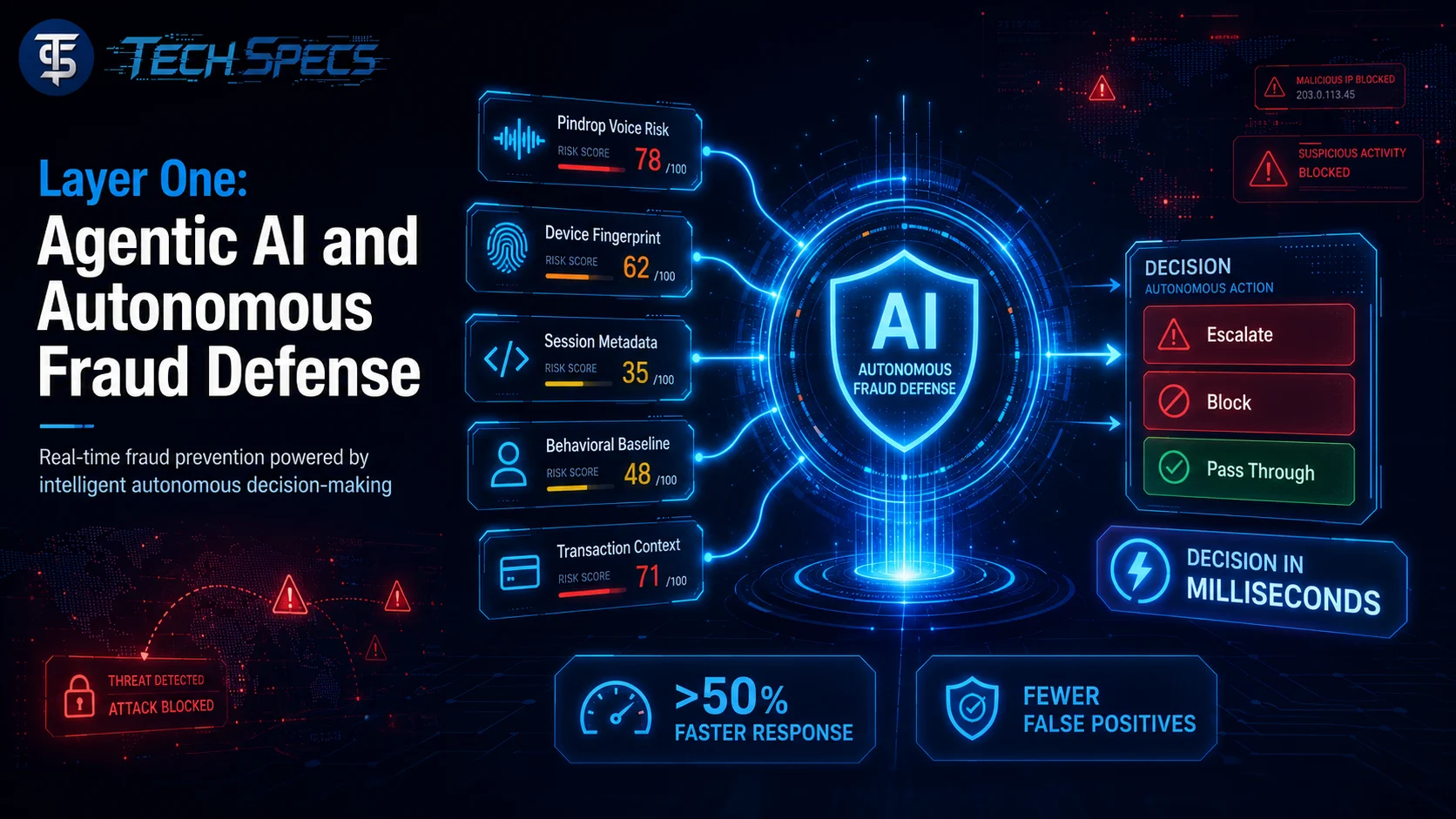
An autonomous fraud defense system powered by the agentic AI component of the agentic AI Pindrop Anonybit stack handles this in real time. It reads Pindrop’s voice risk score. It checks the device fingerprint. It reviews the session metadata. It compares the request to the account’s behavioral baseline. It considers the transaction type and amount. And it makes a decision in milliseconds: escalate, block, or pass through.
Organizations deploying agentic AI in fraud prevention report incident response times cut by more than 50% compared to rule-based setups. That speed advantage is what separates organizations that stop fraud from those that discover it after the fact.
There is another dimension that matters just as much: false positive management. One of the biggest complaints about traditional fraud detection is that it blocks too many legitimate customers. The agentic AI layer in agentic AI Pindrop Anonybit understands context. It separates a customer calling from an unusual location because they are traveling from a bot calling from an unknown device with a cloned voice. It reduces false positives dramatically, meaning fewer legitimate customers are locked out, fewer support escalations, and a better overall experience.
In March 2026, Pindrop announced Pindrop Protect Fraud Assist, the first agentic fraud investigation and case management solution built specifically for real-time phone fraud. The system embeds agentic AI directly into the fraud investigation workflow, delivering real-time call summaries, deep risk insights, and automated case documentation without requiring additional headcount. This is the agentic AI Pindrop Anonybit philosophy in action: not just detecting fraud but actively managing the investigation process alongside human analysts.
Layer Two: Pindrop and Real-Time Voice Fraud Detection
Pindrop is the market leader in voice fraud detection, and the reason for that position is straightforward. They have been doing this longer and at a greater scale than anyone else.
Since its founding, Pindrop has analyzed more than 5 billion calls. Their models are trained on over 1.5 billion real-world interactions annually and protected by more than 300 patents. When a call hits a Pindrop-protected contact center, the system does not just check whether a voice matches a voiceprint on file. It performs a full acoustic forensics analysis in real time.
Here is what that means practically.
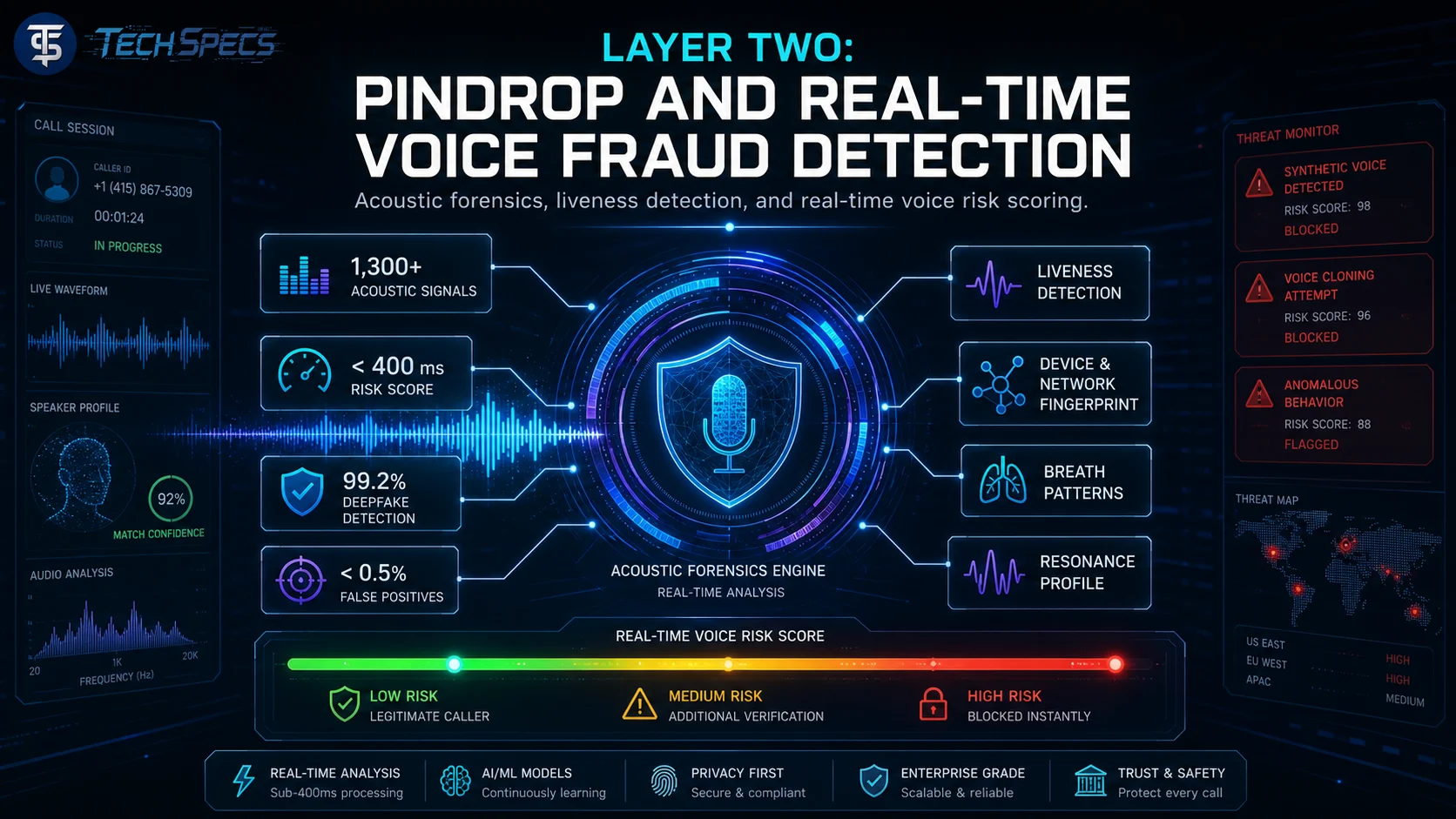
Pindrop analyzes over 1,300 acoustic characteristics per call. These include frequency artifacts, because AI-generated voices consistently show anomalies in specific frequency ranges that human hearing cannot detect. They include breath patterns, because natural human voices have organic breath pauses while synthetic voices either omit them or place them unnaturally. They include resonance profiles, because the physical structure of the human vocal tract produces characteristics that even the best voice cloning models struggle to replicate. They include network and device fingerprints, capturing the digital signature of the call’s origin. And they include liveness signals, the subtle markers of biological voice production that synthetic voices consistently fail to reproduce.
The result is a risk score generated in under 400 milliseconds, before the caller has finished their opening sentence. High-risk calls are flagged immediately. Legitimate callers pass through with zero friction and zero additional steps.
The accuracy figures are exceptional. Pindrop reports a 99.2% deepfake detection accuracy rate when liveness detection and voice authentication operate together. Their platform achieves a false positive rate of less than 0.5%, meaning fewer than 1 in 200 legitimate callers ever gets incorrectly flagged.
For context, humans can detect video deepfakes roughly 60% of the time. For audio deepfakes, that number drops to just 35%. Without AI-powered fraud prevention technology like Pindrop, your human agents are wrong nearly two out of three times when trying to assess whether a voice is real. That is not a manageable risk. That is a structural vulnerability.
The contact center security integration footprint matters for any enterprise evaluating agentic AI Pindrop Anonybit. Pindrop currently integrates natively with Amazon Connect, Genesys, Cisco Webex, Five9, Zoom Contact Center, and NICE CX One. You do not replace your existing contact center platform. Pindrop sits alongside it, processes calls in parallel, and returns risk signals in real time. Your agents see a simple red, yellow, or green risk indicator. The customer experience does not change at all for legitimate callers.
In 2026, TIME magazine named Pindrop to its list of the most influential software companies, alongside Microsoft, Adobe, and Figma. That recognition confirms what enterprise security leaders already know: real-time threat response for voice channels has become a core infrastructure requirement, not a nice-to-have feature.
Layer Three: Anonybit and Decentralized Biometric Identity
Now we reach the layer that most security discussions skip over, and it is arguably the most important one for long-term fraud prevention.
Here is the problem that Anonybit solves.
Traditional biometric security has a fatal architectural flaw. When you store a customer’s voiceprint, faceprint, or fingerprint in a centralized database, that database becomes a high-value target. Security professionals call this a honeypot. Hackers know that one successful breach permanently exposes every single enrolled identity.
And here is why that is catastrophic in a way that a password breach is not: you can reset a password. You cannot reissue a fingerprint, a face, or a voice. Once biometric data is stolen, it is compromised forever. The victim has no recovery path. This is exactly why the Anonybit layer in agentic AI Pindrop Anonybit is so strategically important.
Anonybit’s solution is architectural: eliminate the centralized database entirely.
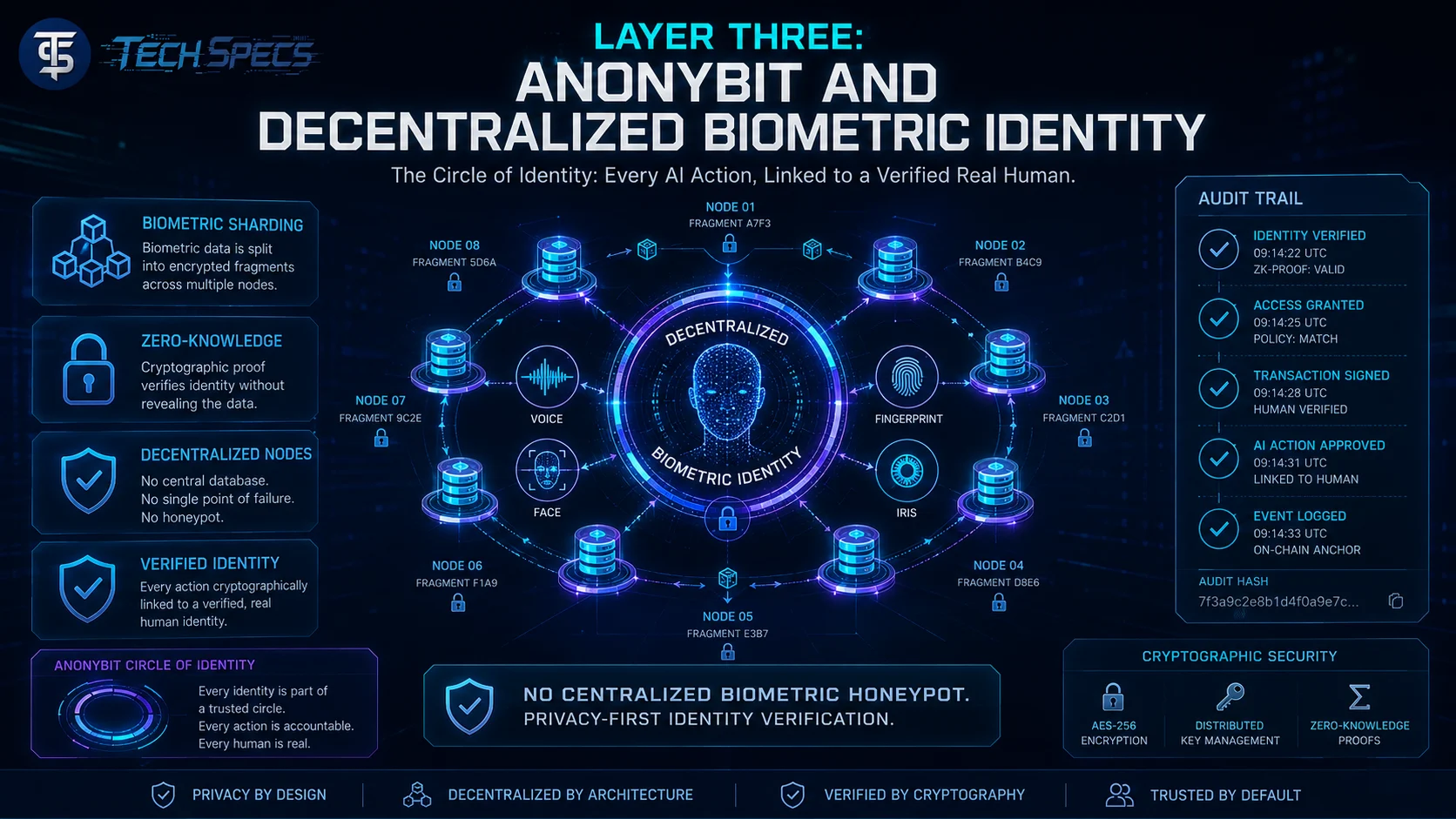
Instead of storing a complete biometric template in one location, Anonybit uses a process called biometric sharding. The biometric record is broken into encrypted fragments and distributed across multiple nodes in a decentralized network. No single node holds a complete record. No single node holds enough information to reconstruct a usable credential. A breach of even multiple nodes yields nothing actionable for an attacker.
When a user needs to authenticate, the system captures the current biometric input (voice, face, fingerprint, or iris), creates new encrypted fragments from that input, compares them against stored shards using zero-knowledge cryptography, and confirms or denies identity without ever reconstructing the original biometric record anywhere in the chain.
Anonybit calls this framework the Circle of Identity. It is a model where biometric data authorizes actions cryptographically, linking every AI-driven decision back to a verified, real human. Every authentication event creates a cryptographic proof that a specific, verified person authorized a specific action.
For regulated industries, this matters enormously. The Circle of Identity creates an audit trail, documentation of who approved what, when, and through what verification chain, without maintaining a centralized data store that regulators would classify as high-risk.
The compliance alignment within the agentic AI Pindrop Anonybit framework is built in from the start. GDPR is supported because no single system ever holds a complete biometric record, directly supporting data minimization principles. CCPA exposure is reduced because decentralized storage limits the organization’s liability for biometric data. HIPAA alignment is maintained because there is no central biometric database to protect under healthcare data rules. SOC 2 trust principles are supported across security, availability, and confidentiality dimensions.
In May 2025, Anonybit launched its secure agentic workflows product, described as the first production-grade implementation of agentic commerce scenarios using decentralized biometrics. In July 2025, a further integration with no-code platform SmartUp extended the framework to security teams without dedicated engineering resources. This is not theoretical technology. It is deployed and running in production environments today, making agentic AI Pindrop Anonybit a real, battle-tested solution.
How Agentic AI Pindrop Anonybit Stops a Real Attack
Understanding each technology in isolation is useful. Seeing how agentic AI Pindrop Anonybit coordinates during a real-world attack scenario is where the power of this approach becomes undeniable.
The scenario: A fraud ring has obtained 45 seconds of a customer’s voice from a public earnings call recording. Using a commercial TTS engine, they have cloned the voice. They have built an agentic AI bot and programmed it to call the customer’s bank and initiate a $50,000 wire transfer.
The bot dials in at 2:34 PM.
In the first 400 milliseconds, Pindrop activates. The call enters the contact center. Pindrop Pulse immediately begins analyzing the audio stream in real time. It processes over 1,300 acoustic features simultaneously. It detects frequency artifacts consistent with TTS synthesis. It notes the absence of natural breath-pause variance. It flags an anomalous resonance profile. Risk score: 87 out of 100, generated before the bot has finished saying hello.
From 400 to 800 milliseconds, the agentic AI layer reasons across all available signals. It receives Pindrop’s high-risk score. It checks the device fingerprint and finds an unknown device not registered to this account. It checks session metadata and finds the call is originating from a data center IP address, not a residential or mobile network. It reviews the behavioral baseline and finds the requested wire transfer falls far outside the account’s normal transaction history. It checks account history and finds this account was flagged in a recent data breach notification. All five signals combine into one clear conclusion: this is not a legitimate caller.
From 800 to 1,200 milliseconds, Anonybit confirms. The agentic coordinator requests biometric verification from Anonybit’s Circle of Identity framework. The customer’s identity was enrolled via multimodal verification, voice plus face. The system attempts to match the incoming audio against stored biometric shards. The fragments do not align. No cryptographic proof of identity. The legitimate account holder’s authorization cannot be confirmed.
Result: Three independent layers, three red flags. The call is immediately routed to a specialized fraud investigation queue. The account is flagged for high-risk monitoring. The account holder is contacted via a verified secure channel. The transfer never happens.
Total elapsed time: under 200 milliseconds.
A legitimate customer calling from their phone at a normal time with a consistent behavioral pattern sails through all three agentic AI Pindrop Anonybit checks without ever knowing the verification happened. No security questions. No friction. No delays. This is what makes the framework so powerful: invisible to legitimate users and impenetrable to fraudulent ones.
Real Business Results From Agentic AI Pindrop Anonybit Deployments
The agentic AI Pindrop Anonybit architecture is not theoretical. Real organizations are running this stack and measuring real outcomes.
In healthcare, one U.S. health payer used the integrated agentic AI Pindrop Anonybit platform to detect and contain a coordinated attack targeting 1,200 patient accounts in February 2026. Estimated fraud exposure if the attack had succeeded: $18 million. The system caught every attempt in real time, with Pindrop reporting 99.2% accuracy when liveness detection and voice authentication operate together.
In financial services, Michigan State University Federal Credit Union redesigned its contact center authentication using Pindrop’s voice analysis and real-time risk intelligence. The results included reduced authentication friction, earlier and more accurate detection of deepfake and synthetic voice fraud attempts, improved agent confidence, and faster verification times, all without adding headcount or disrupting the customer experience.
Across enterprise contact center deployments using agentic AI Pindrop Anonybit, operators consistently report caller authentication completed in under 5 seconds, up to 90% reduction in manual security questions, an 80% or higher fraud detection rate, a false positive rate below 0.5%, and fraud investigations resolved faster without increasing analyst headcount.
One retail client discovered through Pindrop analysis that AI bots were requesting $21 returns across thousands of calls. This was an attack that would have been invisible to traditional fraud tools because each individual transaction was too small to trigger standard alerts. The agentic AI layer in the agentic AI Pindrop Anonybit stack detected the coordinated pattern across calls, not just within individual interactions.
These results confirm what security professionals already understand: agentic AI Pindrop Anonybit works because it addresses fraud at every layer simultaneously, not just at the surface level.
Who Needs Agentic AI Pindrop Anonybit Most
The agentic AI Pindrop Anonybit framework delivers the highest immediate return on investment in environments where voice authentication is critical and fraud exposure is substantial.
Banking and financial services represent the clearest use case. Wire transfer authorization, account recovery, and high-value transaction approval are the highest-risk interactions in any financial institution. The agentic AI Pindrop Anonybit stack addresses all three fraud vectors simultaneously: synthetic voice, stolen identity, and automated fraud agents.
Healthcare organizations face unique pressures. Patient data breaches carry severe regulatory and reputational consequences. Healthcare contact centers handle sensitive account access, prescription information, and insurance details. Pindrop’s February 2026 healthcare expansion specifically addresses this sector’s vulnerabilities, and the HIPAA-aligned architecture of Anonybit’s decentralized biometrics makes the agentic AI Pindrop Anonybit combination particularly suitable for regulated healthcare environments.
Insurance companies dealing with claims fraud find the combination of real-time voice fraud detection and decentralized biometric identity verification directly closes the two most common attack vectors in their sector.
Large contact center operations in telecom, retail, government services, and utilities face the same challenge: scale makes human review impossible. AI-powered fraud prevention through the agentic AI Pindrop Anonybit framework automates detection and response without adding headcount or slowing down legitimate customer interactions.
Deployment Mistakes to Avoid With Agentic AI Pindrop Anonybit
Deploying the agentic AI Pindrop Anonybit stack successfully requires avoiding a few predictable mistakes.
The first mistake is turning on aggressive autonomous responses immediately. The worst thing you can do is deploy the agentic AI component at full aggression on day one. Start in monitoring mode. Let the system observe and score calls for 30 days. Analyze the false positive rate in your specific environment. Tune decision thresholds before enabling active blocking. An over-tuned system that blocks legitimate customers creates its own operational crisis.
The second mistake is skipping staff training. Frontline agents need to understand what the system’s risk indicators mean. If an agent sees a red-flag alert from the agentic AI Pindrop Anonybit system and does not know the proper escalation procedure, the detection is wasted. Training is about making sure your people can act on the system’s outputs confidently and correctly.
The third mistake is poor audit trail configuration. When an autonomous system blocks a transaction, someone will eventually ask why. You need complete decision logs covering what signals triggered the decision, what the risk scores were, and what action was taken. Without these logs, you are exposed to regulatory questions and customer disputes that you cannot answer.
The fourth mistake is treating biometric enrollment as optional. Anonybit’s Circle of Identity is only as strong as your enrollment process. If you skip multimodal enrollment and collect only voice without face verification, you reduce the authentication strength significantly. Define enrollment requirements upfront and enforce them consistently across every channel where agentic AI Pindrop Anonybit is active.
The ROI Case for Agentic AI Pindrop Anonybit
Security investments always face scrutiny. Here is how to frame the business case clearly.
The cost of inaction is quantifiable. At 2.6 million fraud incidents in 2024 and $12.5 billion in industry losses, the average contact center fraud incident costs approximately $4,800. For a mid-size financial institution handling 500,000 calls per month, with 1 in 599 flagged as fraud, that is potentially 836 fraudulent calls every month. At $4,800 average loss per incident, that is over $4 million in annual exposure from voice fraud alone.
The deployment cost for agentic AI Pindrop Anonybit is dramatically lower than that exposure. Pindrop integrates with existing contact center infrastructure, requiring no rip-and-replace. Anonybit’s enrollment process is designed for enterprise scale. The total cost of implementation, even at enterprise scale, is typically recovered within 6 to 12 months through fraud prevention alone.
The operational savings compound over time. Fewer fraud incidents mean fewer investigation hours, fewer customer service escalations, and fewer regulatory compliance issues. Organizations consistently report that the agentic AI layer resolves more cases faster without adding headcount, directly reducing operational cost.
The customer experience also improves. When the agentic AI Pindrop Anonybit system stops blocking legitimate customers with false positives, when authentication happens passively in the background, and when calls flow without friction, customer satisfaction scores rise alongside the security posture.
The Future of Agentic AI Pindrop Anonybit
The fraud landscape will keep evolving. The same tools that make agentic AI Pindrop Anonybit powerful for defenders are available to attackers. Voice cloning technology improves monthly. AI fraud agents are getting smarter. The attack surface is expanding beyond phone calls into video meetings, chat, and automated API interactions.
The organizations that stay ahead of this curve are those that deploy adaptive, learning-based defenses rather than static rule sets, maintain layered architectures that do not depend on any single point of detection, invest in audit trails and explainability to satisfy regulators and internal stakeholders, and treat biometric data architecture as a strategic decision rather than a purely technical one.
The combination of agentic AI for autonomous decision-making, Pindrop for real-time voice fraud detection, and Anonybit for privacy-preserving decentralized identity is not just the best available answer to today’s fraud environment. It is the right architectural foundation for wherever the threat landscape goes next. Organizations that deploy agentic AI Pindrop Anonybit today are not just solving a current problem. They are building a security posture designed to adapt as threats evolve.
Final Thoughts
The fraud crisis of 2026 is being driven by the same technology that powers legitimate AI applications. Attackers have access to voice cloning, autonomous agents, and scalable automation. They are deploying these tools against contact centers that were designed for human-speed attacks.
Agentic AI Pindrop Anonybit represents a direct, practical, and proven response to this challenge. Each layer addresses a distinct attack vector. Pindrop handles synthetic voice. Anonybit secures biometric identity. The agentic AI layer makes autonomous fraud defense decisions in real time. Together, they create a fraud defense posture that adapts continuously, operates without friction for legitimate customers, and scales to handle whatever attack volume comes next.
For business leaders, the question is not whether the agentic AI Pindrop Anonybit framework is necessary. The data already answers that. The question is how quickly your organization can close the gap between where your fraud defenses are today and where they need to be.
Every day without agentic AI Pindrop Anonybit protection is a day your contact center is operating below the threat level it is actually facing. The time to act is now.
Subscribe for the latest AI tools, tech guides, and expert insights. Also, find us on Google.
Frequently Asked Questions About Agentic AI Pindrop Anonybit
Q1. What is agentic AI Pindrop Anonybit and how does it work?
Agentic AI Pindrop Anonybit is a three-layer fraud defense system combining autonomous AI, voice fraud detection, and decentralized biometrics.
Q2. Why is agentic AI Pindrop Anonybit better than traditional fraud prevention?
It uses autonomous fraud defense and real-time threat response instead of slow, static rules that modern AI-powered attacks easily bypass.
Q3. What is voice fraud detection and why does it matter in 2026?
Voice fraud detection identifies AI-generated or cloned voices on calls, and in 2026 it is critical because deepfake audio attacks have surged over 1,200%.
Q4. How does agentic AI Pindrop Anonybit support contact center security?
It layers voice scoring, biometric verification, and autonomous decision-making on every call, cutting manual security questions by up to 90%.
Q5. What is autonomous fraud defense and how does the agentic AI layer deliver it?
Autonomous fraud defense means the system detects and stops fraud on its own without waiting for a human, cutting response times by over 50%.
Q6. Is agentic AI Pindrop Anonybit suitable for healthcare organizations?
Yes. It aligns with HIPAA requirements and helped one healthcare organization prevent $18 million in fraud in a single attack.
Q7. How accurate is Pindrop’s voice fraud detection technology?
Pindrop’s voice fraud detection reaches 99.2% accuracy with a false positive rate below 0.5%.
Q8. What makes Anonybit different from other biometric identity solutions?
Anonybit uses biometric sharding to eliminate the central database honeypot, making stolen data completely useless to attackers.
Q9. What does real-time threat response mean in the context of agentic AI Pindrop Anonybit?
Real-time threat response means the full detect, reason, and block cycle completes in under 200 milliseconds on every single call.
Q10. Which industries benefit most from agentic AI Pindrop Anonybit?
Banking, healthcare, insurance, and large contact center operations get the highest ROI from the agentic AI Pindrop Anonybit stack.
Q11. How does agentic AI Pindrop Anonybit handle false positives?
The agentic AI layer reasons across multiple signals together, not just one, keeping the false positive rate under 0.5% for contact center security.
Q12. What compliance standards does agentic AI Pindrop Anonybit support?
Agentic AI Pindrop Anonybit supports GDPR, CCPA, HIPAA, and SOC 2 through Anonybit’s decentralized biometric architecture.
Q13. How long does it take to deploy agentic AI Pindrop Anonybit?
Most enterprise deployments of agentic AI Pindrop Anonybit are fully active within 90 to 180 days using existing infrastructure.
Q14. What is the ROI of deploying agentic AI Pindrop Anonybit?
Most organizations recover the full cost of agentic AI Pindrop Anonybit within 6 to 12 months purely through fraud prevention savings.
Q15. Is agentic AI Pindrop Anonybit the future of enterprise fraud defense?
Yes. Agentic AI Pindrop Anonybit is the leading architecture for autonomous fraud defense as AI-powered attacks continue to scale in 2026 and beyond.