
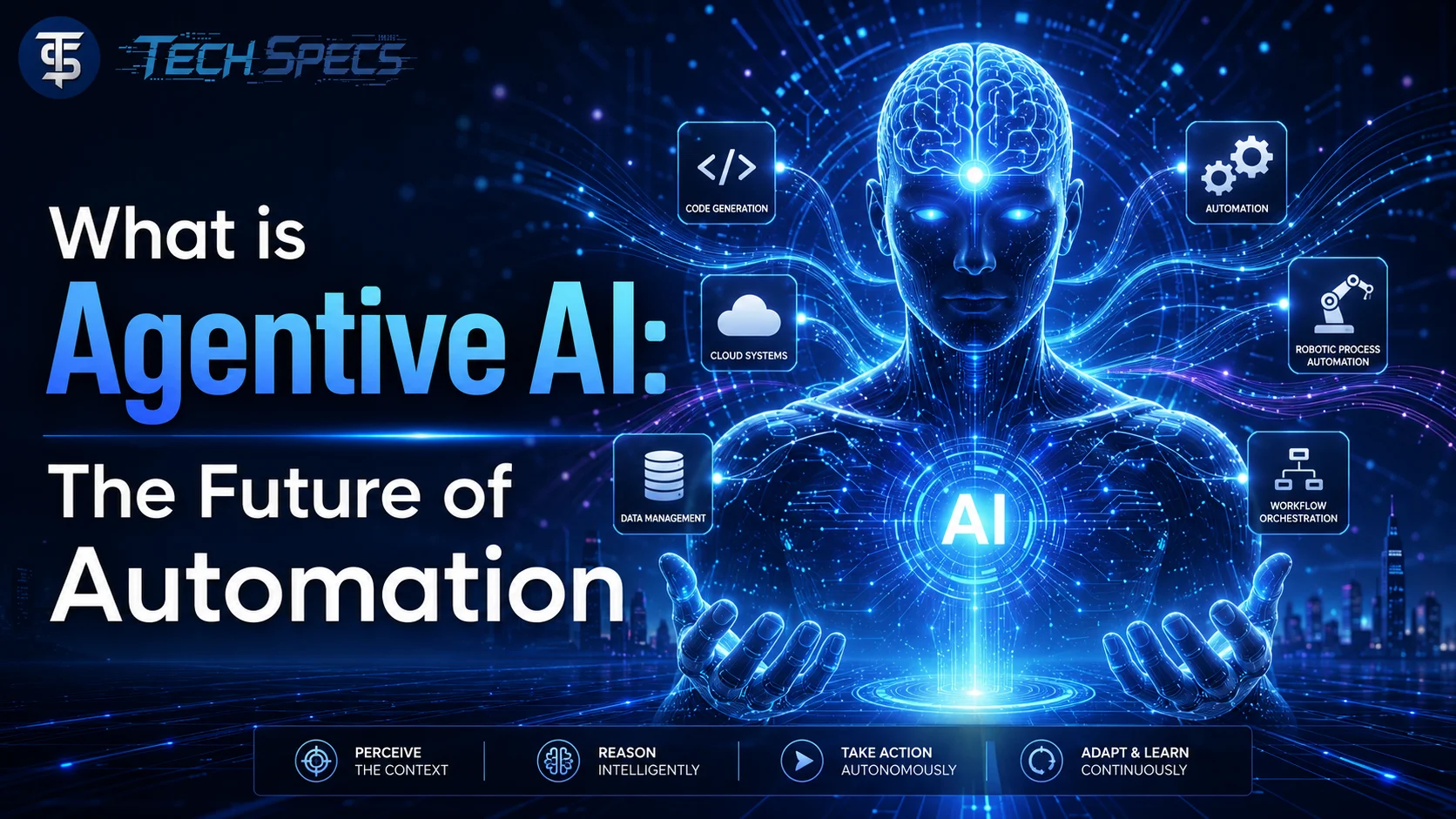

Artificial intelligence is evolving faster than most people expected. A few years ago, AI was mostly a tool that responded to commands. You asked a question, it gave an answer. You clicked a button, it completed a task. That was it. But something bigger is happening now, and it is changing the way businesses, developers, and everyday users interact with technology.
What is agentive AI? It is one of the most important shifts in the entire history of artificial intelligence. Unlike traditional AI that waits for instructions, agentive AI can think, plan, and act on its own to complete complex goals. It does not just respond. It takes initiative.
This guide by Tech Specs will walk you through the agentive AI definition, agentive AI meaning, how it works, why it matters, and where it is headed. Whether you are a business owner, a tech enthusiast, or simply someone curious about the future of automation, this is everything you need to know.
What is Agentive AI? A Clear and Simple Explanation
At its core, agentive AI refers to artificial intelligence systems that are designed to act as autonomous agents. These systems can pursue goals, make decisions, take actions, and adapt to changing conditions, all without needing constant human input.
The word “agentive” comes from the concept of agency, which means the ability to act independently and make choices. When we apply that concept to artificial intelligence, we get a system that does not just process information but actually does something with it.
Think of it this way:
- A traditional AI chatbot answers your question and stops.
- An agentive AI system reads your question, researches the topic online, drafts a response, checks it for accuracy, and sends it, all on its own.
That is the fundamental difference. Agentive AI does not wait to be told every small step. It understands a goal and figures out how to achieve it.
Agentive AI Definition: Breaking It Down
The agentive AI definition can be stated as follows:
Agentive AI is a class of artificial intelligence that possesses the ability to autonomously perceive its environment, set or receive goals, plan a course of action, execute tasks, and learn from outcomes, all with minimal or no human intervention.
Let’s break that definition into key components:
- Perception: The AI gathers data from its environment, whether that is the internet, a database, a conversation, or a physical sensor.
- Goal setting: It either receives a high-level goal from a human or generates sub-goals on its own.
- Planning: It determines the best sequence of actions to achieve the goal.
- Execution: It carries out those actions using tools, APIs, code, or other systems.
- Learning: It evaluates the results and improves future performance.
This combination of perception, planning, execution, and learning is what separates agentive AI from earlier forms of automation and artificial intelligence.
Agentive AI Meaning: Why the Word “Agentive” Matters
Understanding the agentive AI meaning starts with understanding the root concept of agency. In philosophy and cognitive science, agency refers to the capacity of an entity to act in the world. An agent is something that takes action.
When AI becomes agentive, it stops being a passive tool and becomes an active participant. This is a profound shift because it changes the relationship between humans and machines.
In the past, humans were always in the loop for every small decision. With agentive AI:
- Humans set the objective.
- The AI handles the execution.
- Humans review and approve outcomes when necessary.
This creates a much more efficient workflow. It also opens the door to automation that was simply not possible before, because older systems could not handle ambiguity, complexity, or the need for real-time decision-making.
The agentive AI meaning, in simple terms, is AI that has a degree of independence. It is AI that acts, not just responds.
How Agentive AI Actually Works
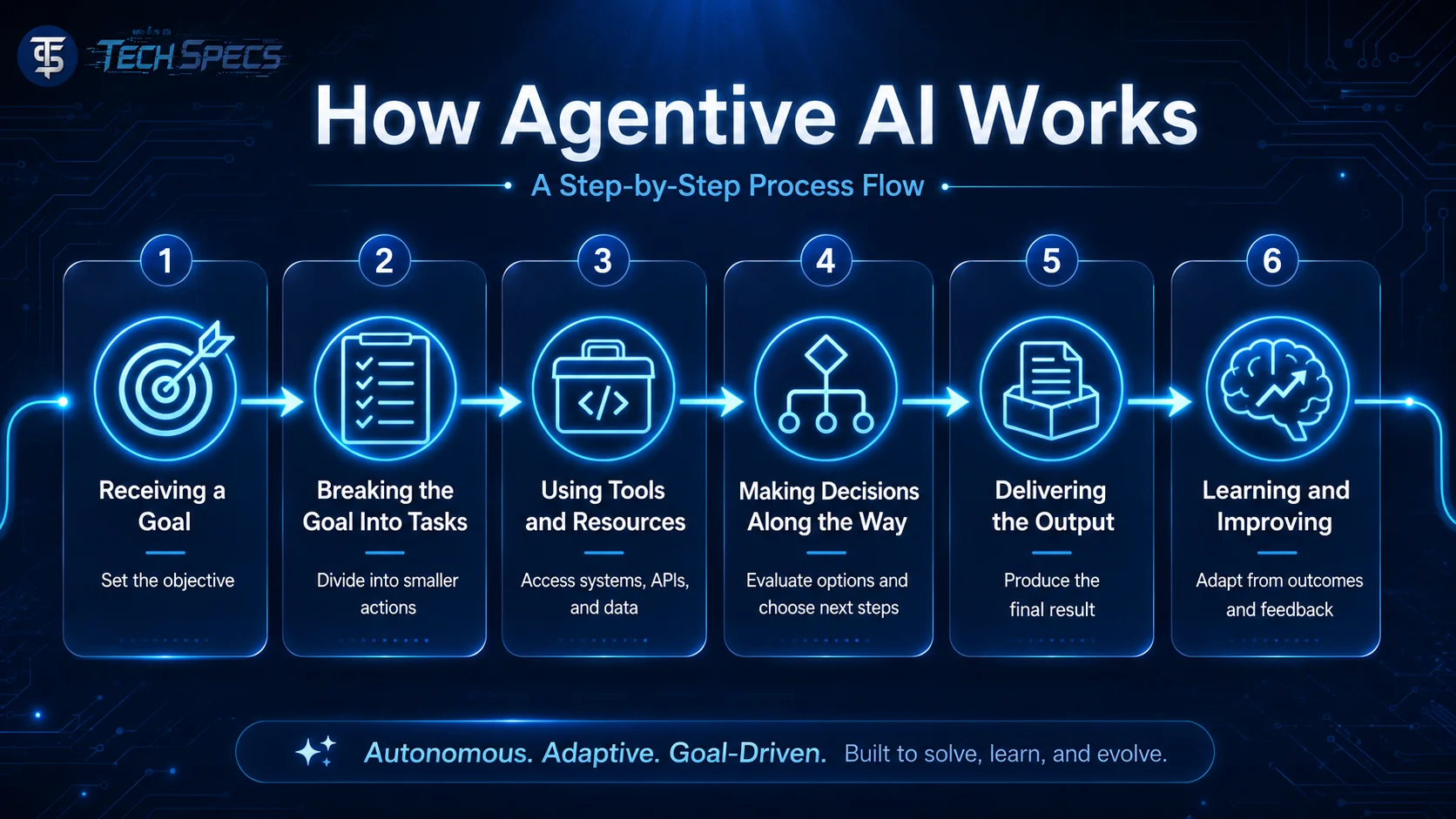
To truly understand what agentive AI is, it helps to look under the hood. Here is how a typical agentive AI system operates:
1. Receiving a Goal A user or system provides a high-level instruction. For example: “Research the top five competitors in this market and prepare a summary report.”
2. Breaking the Goal Into Tasks The agentive AI breaks that broad goal into smaller, manageable steps. It might decide to search the web, analyze data, compare features, and format a document.
3. Using Tools and Resources Modern agentive AI systems have access to tools. These can include:
- Web browsers and search engines
- Code interpreters and calculators
- Email and calendar systems
- Databases and APIs
- File management systems
4. Making Decisions Along the Way As it works through the tasks, the AI encounters decisions. Maybe one website is blocked. Maybe the data is incomplete. The AI adapts, finds alternatives, and keeps moving toward the goal.
5. Delivering the Output Once the goal is achieved, the AI delivers the result. This could be a document, a completed action, an email sent, or a report filed.
6. Learning and Improving Some agentive AI systems remember what worked and what did not. They use this information to perform better on similar tasks in the future.
Key Characteristics of Agentive AI
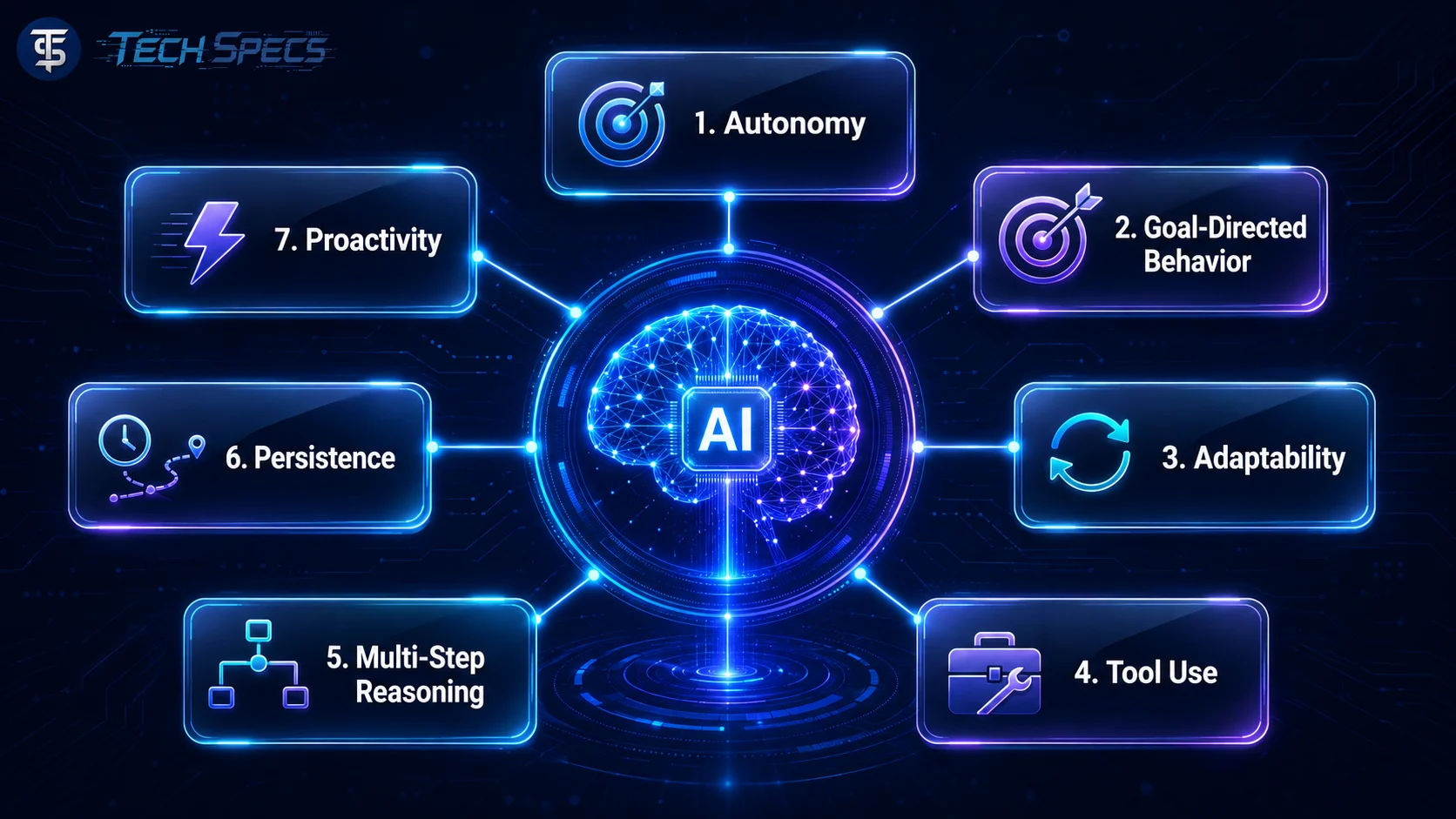
What sets agentive AI apart from other types of artificial intelligence? Here are the defining characteristics:
- Autonomy: It can act without step-by-step human instructions.
- Goal-directed behavior: It focuses on achieving a specific outcome.
- Adaptability: It adjusts its approach when faced with obstacles or new information.
- Tool use: It interacts with external systems, software, and data sources.
- Multi-step reasoning: It can handle complex, multi-stage tasks.
- Persistence: It continues working on a task over time, not just in a single interaction.
- Proactivity: In some cases, it can identify opportunities or problems and act without being asked.
These characteristics combine to create something far more powerful than a simple question-and-answer AI model.
Agentive AI vs Traditional AI: The Core Differences
It is worth pausing to compare agentive AI with the traditional AI systems most people are familiar with.
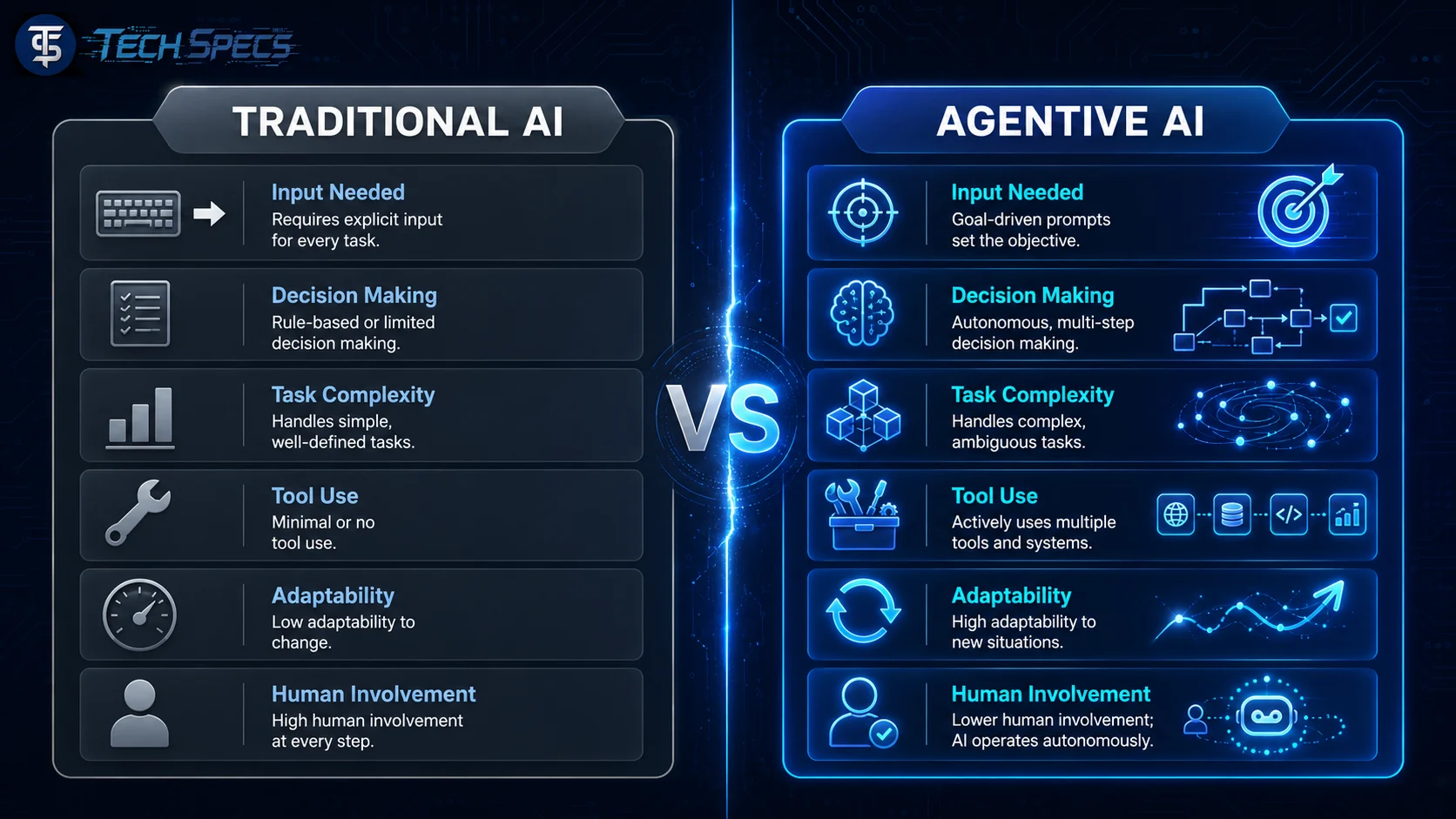
Traditional AI is like a calculator. It does exactly what you tell it, nothing more and nothing less.
Agentive AI is like a skilled employee. You give it a project, and it figures out how to complete it, asks questions only when necessary, and delivers results.
Real-World Applications of Agentive AI
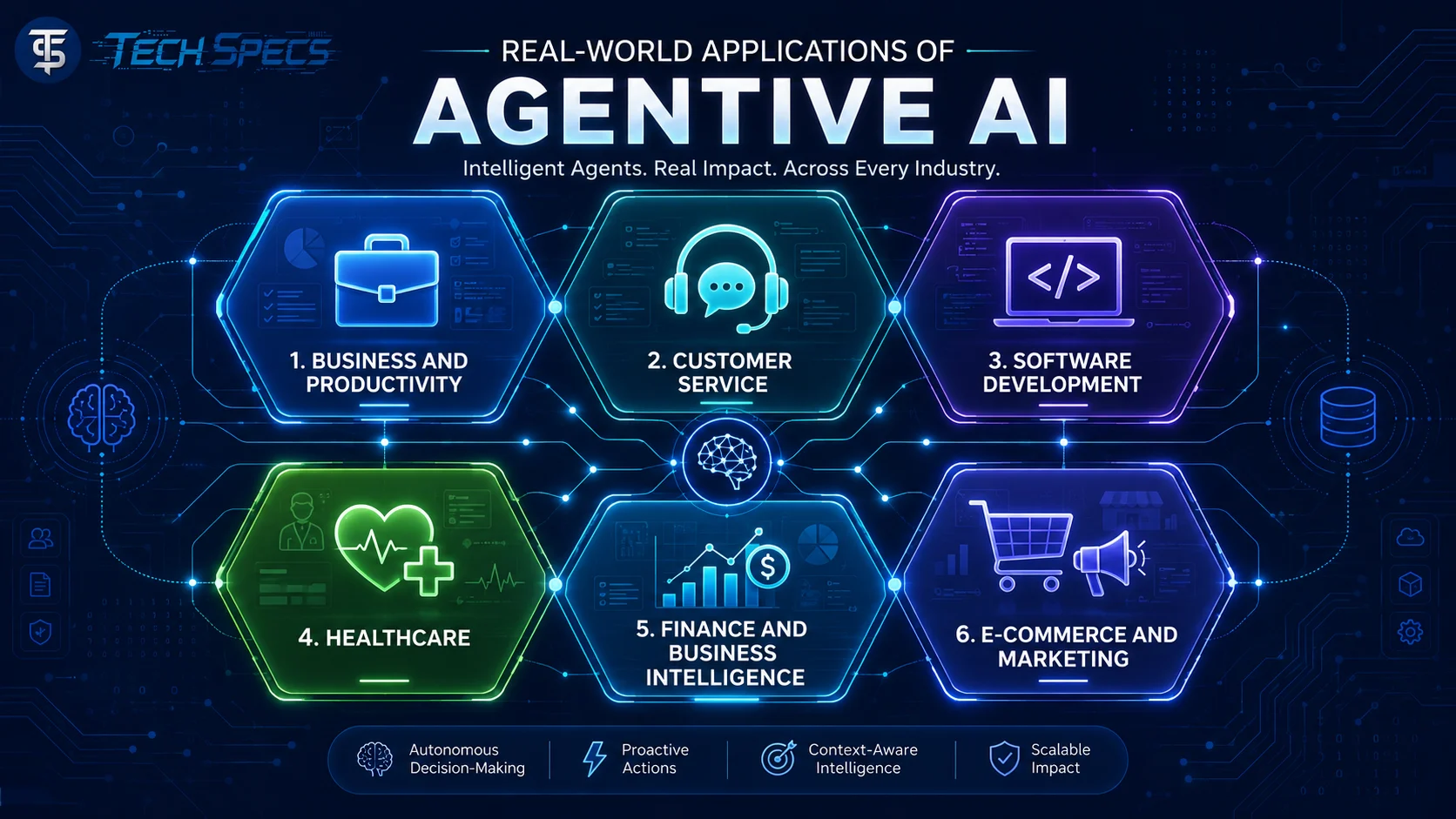
The agentive AI definition becomes much more tangible when you see where it is being used today. Autonomous intelligence is already making an impact across many industries.
Business and Productivity
- Automatically drafting, editing, and sending emails based on incoming messages
- Managing project timelines and updating stakeholders without manual input
- Researching topics, compiling reports, and generating summaries
Customer Service
- Resolving customer complaints end-to-end without human agents
- Booking appointments, processing refunds, and updating account information
- Escalating issues to humans only when truly necessary
Software Development
- Writing, testing, and debugging code autonomously
- Reviewing pull requests and suggesting improvements
- Managing deployment pipelines and monitoring systems
Healthcare
- Reviewing patient records and flagging potential health risks
- Scheduling follow-up appointments and sending reminders
- Assisting in research by scanning and summarizing medical studies
Finance and Business Intelligence
- Monitoring financial markets and generating alerts
- Preparing expense reports and reconciling accounts
- Analyzing business data and recommending actions
E-commerce and Marketing
- Running A/B tests and optimizing ad campaigns automatically
- Personalizing product recommendations for each user
- Monitoring competitor pricing and adjusting strategies in real time
Autonomous Intelligence: The Engine Behind Agentive AI
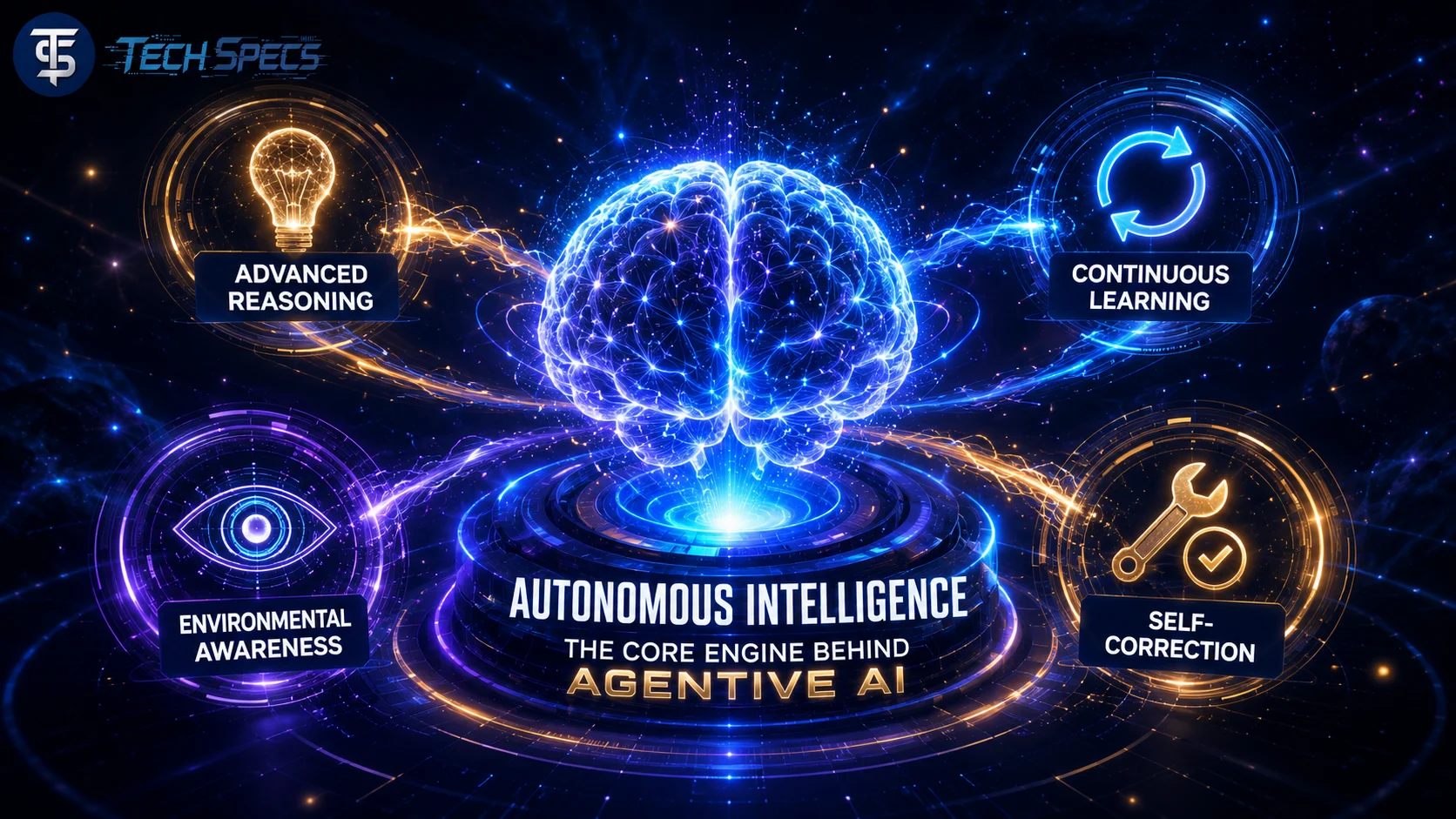
Autonomous intelligence is the broader concept that powers agentive AI. It refers to AI systems that can operate, learn, and make decisions without human supervision.
Autonomous intelligence is not just about speed or efficiency. It is about the AI being able to handle situations it has never encountered before. This requires:
- Advanced reasoning: Understanding context, weighing options, and making judgment calls.
- Continuous learning: Improving performance based on new data and past experiences.
- Environmental awareness: Understanding the state of the world and adjusting accordingly.
- Self-correction: Identifying mistakes and fixing them without being told.
When autonomous intelligence is combined with the ability to take actions in the real world, the result is agentive AI. It is the meeting point of intelligence and action.
Autonomous Technology: A World Shaped by Agentive AI
Autonomous technology is the broader ecosystem that agentive AI is part of. This includes self-driving vehicles, robotic process automation, smart home systems, and industrial robots.
But agentive AI brings something new to autonomous technology. It brings general problem-solving. Most autonomous systems are designed for a narrow task, a robot arm that welds car parts, a navigation system that drives on roads. Agentive AI is more flexible. It can be pointed at almost any task and find a way to complete it.
This flexibility is what makes agentive AI such a powerful force in the future of automation. It is not replacing one specific job or one specific machine. It is providing a general-purpose intelligent agent that can work across domains.
The implications for business are enormous:
- Reduced operational costs through automation of knowledge work
- Faster decision-making with AI handling research and analysis
- Scalability without proportional increases in headcount
- 24/7 availability without breaks, vacations, or sick days
- Consistency in task execution without human error
Challenges and Concerns Around Agentive AI
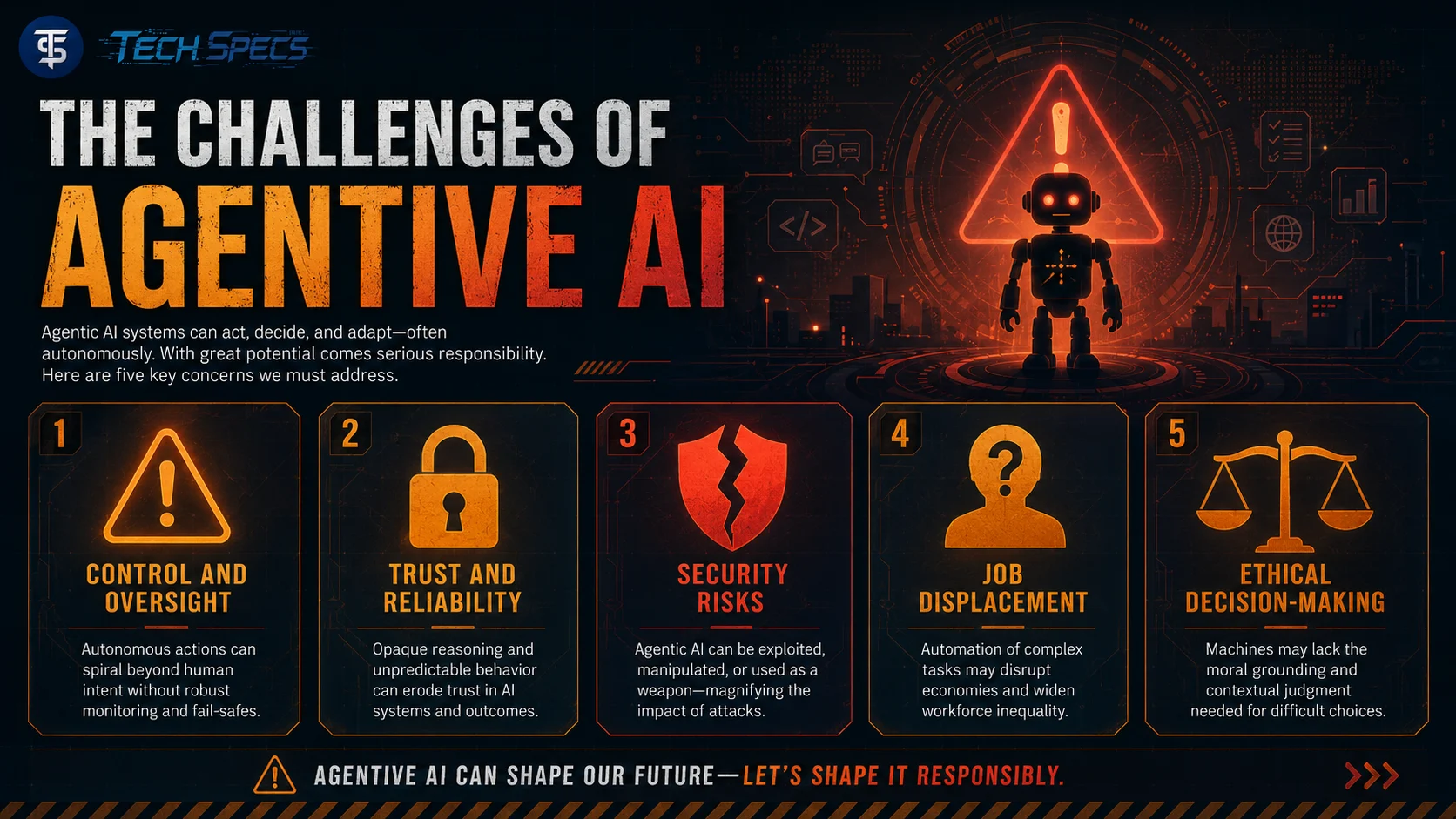
No discussion of what agentive AI is would be complete without addressing the real challenges and concerns that come with it.
Control and Oversight When AI acts autonomously, maintaining human oversight becomes more difficult. There is always a risk that the AI takes an action that was not intended or causes harm by pursuing a goal in an unexpected way.
Trust and Reliability Businesses need to trust that agentive AI will perform correctly before handing over important tasks. Building that trust requires testing, transparency, and clear error-handling processes.
Security Risks Agentive AI systems have access to tools, data, and systems. If they are compromised or manipulated, the consequences could be severe.
Job Displacement As agentive AI takes over more complex knowledge work, there are legitimate concerns about the impact on employment. This is a societal challenge that governments and businesses will need to address thoughtfully.
Ethical Decision-Making When AI makes autonomous decisions, questions arise about accountability. If an agentive AI makes a harmful decision, who is responsible? The developer, the company, or the user?
These are not reasons to avoid agentive AI. They are reasons to develop and deploy it carefully, with proper governance frameworks in place.
The Future of Agentive AI
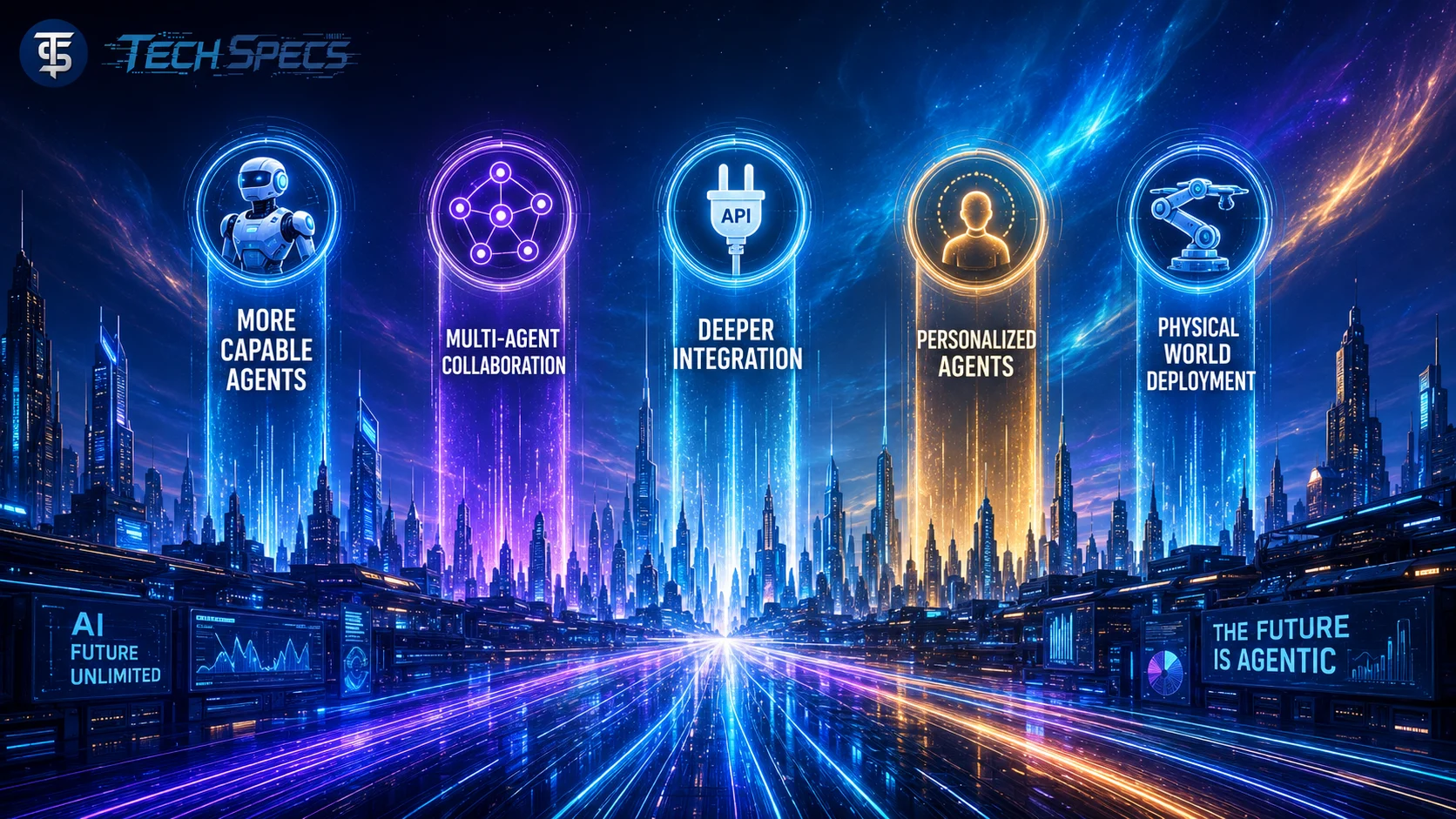
The future of agentive AI is both exciting and transformative. Here is where things are headed:
- More capable agents: Future systems will handle even more complex, multi-month projects with minimal human involvement.
- Multi-agent collaboration: Multiple agentive AI systems will work together, each handling a specialized domain, to complete large-scale tasks.
- Deeper integration: Agentive AI will be embedded into every major software platform, from CRMs to design tools to data systems.
- Personalized agents: Individuals will have their own agentive AI that knows their preferences, goals, and working style and acts accordingly.
- Physical world deployment: Agentive AI will increasingly control robots and physical systems, not just digital tasks.
We are at the very beginning of this transformation. The businesses and individuals who understand what agentive AI is and start working with it today will have a significant advantage in the years ahead.
Final Thought
What is agentive AI? It is one of the most significant technological developments of our time. It is the evolution from AI that responds to AI that acts. From AI that needs constant instruction to AI that can pursue goals, make decisions, use tools, and deliver results on its own.
The agentive AI definition is clear: it is an autonomous intelligence system designed to perceive, plan, execute, and learn in pursuit of goals with minimal human intervention. Its meaning goes beyond technology. It represents a fundamental change in how work gets done, how businesses operate, and how humans interact with machines.
Autonomous technology powered by agentive AI is not a distant future concept. It is here, growing rapidly, and reshaping industries right now. Understanding it is not optional for those who want to stay competitive. It is essential.
Whether you are looking to use it in your business, build it into your products, or simply stay informed, the time to learn about agentive AI is now.
Subscribe now or find us on Google.
Frequently Asked Questions About Agentive AI
1. What is agentive AI in simple terms?
Agentive AI is artificial intelligence that can act on its own to complete goals. Instead of waiting for step-by-step instructions, it receives a high-level objective and figures out how to achieve it using available tools and resources.
2. What is the agentive AI definition?
The agentive AI definition refers to AI systems that autonomously perceive their environment, plan a course of action, execute tasks using tools, and learn from outcomes, all with minimal or no human intervention.
3. What does agentive AI meaning refer to in technology?
In technology, agentive AI meaning refers to AI that has agency, meaning the ability to act independently. It is AI that takes initiative and performs multi-step tasks rather than simply responding to single commands.
4. How is agentive AI different from traditional AI?
Traditional AI responds to specific inputs and requires human direction at every step. Agentive AI receives a goal and autonomously plans, decides, and acts to achieve it, adapting to challenges along the way.
5. What are some real-world examples of agentive AI?
Real-world examples include AI systems that autonomously manage customer service, write and debug code, research and compile reports, run marketing campaigns, and handle scheduling and email management without ongoing human input.
6. Is agentive AI the same as autonomous intelligence?
They are closely related. Autonomous intelligence is the broader concept of AI that operates independently. Agentive AI is a specific application of autonomous intelligence that focuses on goal-directed action and task execution.
7. What tools does agentive AI use?
Agentive AI systems commonly use web browsers, search engines, code interpreters, APIs, email systems, calendars, databases, and file management tools to complete tasks autonomously.
8. What industries are using agentive AI today?
Agentive AI is being used across business productivity, customer service, software development, healthcare, finance, e-commerce, and marketing. Its applications are expanding rapidly across almost every sector.
9. What are the risks of agentive AI?
Key risks include loss of human control, security vulnerabilities, unintended actions, job displacement, and ethical questions around accountability for autonomous decisions.
10. What is the future of agentive AI?
The future includes more capable agents, multi-agent collaboration, deeper software integration, personalized AI assistants, and deployment in physical systems. Agentive AI is expected to become a core part of how businesses and individuals operate.