We use cookies for ads and analytics to support our work. You can accept or reject these non-essential cookies. Cookie policy.
A Snapdragon 8 Gen 3 flagship-killer: a 6.67-inch flat 2K (WQHD+) 120Hz AMOLED at 3200 nits, a 50 MP OIS main camera, IP68, and a large 6000 mAh battery with 90W wired charging.

Photos via GSMArena · click to expand · ←/→ keys or swipe to navigate
Quick Specs
The middle F7: a Snapdragon 8 Gen 3, a flat 2K 120Hz AMOLED at 3200 nits, IP68 and a big 6000 mAh battery with 90W charging - flagship endurance and speed, with the camera kept simple.
Buy it for
Think twice if
Overall expert editorial score
| Release Date | March 27, 2025 (Global) |
|---|---|
| Market Status | Available |
| Announcement | March 27, 2025 |
| Dimensions | 160.3 x 75.0 x 8.1 mm |
|---|---|
| Weight | 206 g |
| Build | Glass front (Corning Gorilla Glass 7i), glass back, aluminum frame |
| IP Rating | IP68 (dust tight, immersible up to 2.5 m for 30 min) |
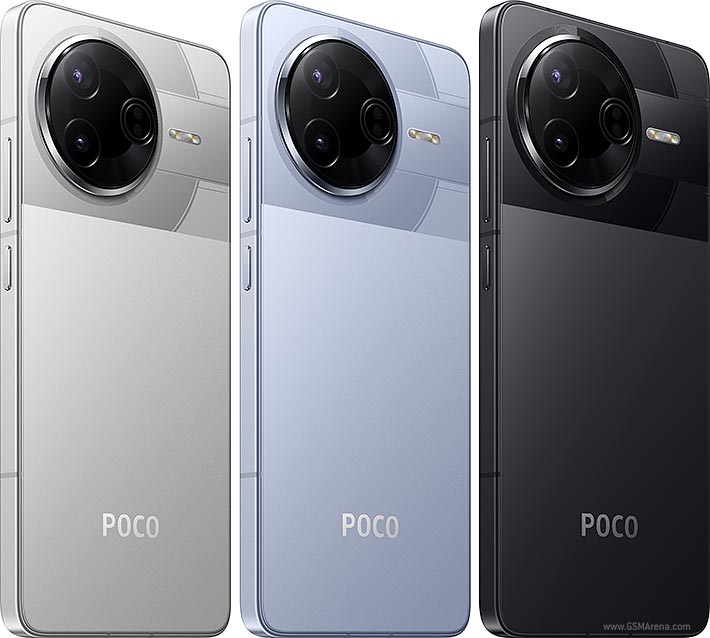
| Colors | Black, Blue, Silver |
| Type | AMOLED, 68B colors, 120Hz, 3840Hz PWM dimming, Dolby Vision, HDR10+ |
|---|---|
| Size | 6.67 inches, flat |
| Resolution | 1440 x 3200 (2K / WQHD+), ~526 ppi |
| Aspect Ratio | 20:9 |
| Pixel Density | ~526 ppi |
| Screen-to-Body Ratio | ~89.3% |
| Refresh Rate | 120Hz |
| Peak Brightness | 1800 nits (HBM) / 3200 nits (peak) |
| Protection | Corning Gorilla Glass 7i |
| Notch | Centered punch-hole |
| Touchscreen | Capacitive, multi-touch, 3840Hz PWM dimming |
| OS | Android 15, HyperOS 2 (up to 4 major OS upgrades, 6 years security) |
|---|---|
| UI | HyperOS 2 |
| Chipset | Qualcomm SM8650-AB Snapdragon 8 Gen 3 (4nm) |
| CPU | Octa-core (1x3.3GHz Cortex-X4 + 3x3.2GHz Cortex-A720 + 2x3.0GHz Cortex-A720 + 2x2.3GHz Cortex-A520) |
| Fabrication | 4 nm |
| GPU | Adreno 750 |
| Architecture | 64-bit |
| RAM | 12 GB (LPDDR5X) |
|---|---|
| Internal Storage | 256 GB / 512 GB (UFS 4.1) |
| Expandable Storage | No (no microSD slot) |
| USB OTG | Yes |
| Setup | Dual (50 MP main + 8 MP ultra-wide) - no telephoto |
|---|---|
| Primary | 50 MP, f/1.6, 24mm, 1/1.55", 1.0µm, dual pixel PDAF, OIS (Light Fusion 800) |
| Ultra-Wide | 8 MP, f/2.2, 1/4.0", 1.12µm |
| Macro | — |
| Flash | LED flash |
| Video | 8K@24fps, 4K@24/30/60fps, 1080p@30/60/120/240/960fps, 720p@1920fps, gyro-EIS |
| Features | Color spectrum sensor, OIS, HDR, panorama, Night mode, 8K video, 2x in-sensor zoom |
| Setup | Single (punch-hole) |
|---|---|
| Resolution | 20 MP, f/2.2, wide, HDR |
| Video | 1080p@30/60fps, gyro-EIS |
| Capacity | 6000 mAh, Li-Po, non-removable |
|---|---|
| Type | Li-Po, non-removable |
| Wired Charging | 90W wired (HyperCharge, PD3.0, QC3+), 100% in ~37 min |
| Wireless Charging | No |
| Port | USB Type-C |
| Network | GSM / HSPA / LTE / 5G |
|---|---|
| 5G | Yes (5G SA/NSA, sub-6) |
| SIM | Dual SIM (Nano-SIM, dual stand-by) |
| Wi-Fi | Wi-Fi 7 (802.11 a/b/g/n/ac/6e/7), dual-band, Wi-Fi Direct |
| Bluetooth | 5.4, A2DP, LE, aptX HD, aptX Adaptive, aptX Lossless, LHDC 5 |
| GPS | GPS (L1+L5), GLONASS, Galileo, BeiDou, QZSS, NavIC |
| NFC | Yes |
| Infrared | Yes (IR Blaster) |
| USB | USB Type-C, OTG |
| Loudspeaker | Yes, stereo speakers |
|---|---|
| 3.5mm Audio Jack | No |
| Audio Output | Hi-Res Audio, Hi-Res Wireless (24-bit/192kHz), Snapdragon Sound |
| Fingerprint | Under-display (ultrasonic) |
|---|---|
| Face Unlock | Yes (software-based) |
| Sensors | Accelerometer, gyroscope, proximity, compass |
Configuration
Across 3 retailers · prices update frequently
Where to buy
Prices and stock are accurate as of the last update. TechSpecs may earn a commission on purchases made through these links, at no extra cost to you.
The Poco F7 Pro is a focused, high-value flagship-killer. The Snapdragon 8 Gen 3 still delivers near-top-tier performance, the 6.67-inch flat 2K 120Hz AMOLED is sharp and bright at 3200 nits, and the large 6000 mAh battery with 90W charging gives it some of the best endurance in its class - bigger, in fact, than the pricier F7 Ultra. The deliberate cut is the camera: an effectively single 50 MP main (plus a token 8 MP ultra-wide) with no telephoto, and there is no wireless charging, headphone jack or microSD. For buyers who value speed, screen and battery over camera versatility, it is one of the smartest value picks of 2025.
Battery and speed are unreal
The 6000mAh battery easily lasts me a day and a half, and 90W charging fills it in well under an hour. The Snapdragon 8 Gen 3 handles every game maxed out. The screen is gorgeous and super bright outside. For the import price this is the best value phone I've used.
Great phone, just the one camera
Performance, display and battery are all flagship level. The main 50MP camera is genuinely good with nice OIS. The only real letdown is there's no telephoto and the ultra-wide is weak - if you zoom a lot, look at the Ultra instead. Otherwise I have no complaints.
Endurance king, missing a few extras
Picked the blue 12/512 as a grey-market import. The battery life is the standout - it just keeps going. No wireless charging and no headphone jack are the trade-offs, and the ultra-wide is forgettable, but the core experience feels like a proper flagship.
Own this device? Share your experience.
Your overall rating
0 / 2000
Pick a star rating to continue.
It runs Qualcomm's 2024 flagship Snapdragon 8 Gen 3 (SM8650-AB), a 4nm chip with an octa-core CPU (a 3.3 GHz Cortex-X4 prime core, five Cortex-A720 performance cores and two Cortex-A520 efficiency cores) and an Adreno 750 GPU. In testing it posts an AnTuTu v10 score around 2.07 million, Geekbench 6 scores of roughly 2205 single-core and 6661 multi-core, and a 3DMark Wild Life Extreme score near 4921 - still genuine flagship-class performance.
The Ultra is the flagship: it uses the newer Snapdragon 8 Elite (vs the F7 Pro's Snapdragon 8 Gen 3) and adds a real camera system - a 50 MP 2.5x floating telephoto and a 32 MP ultra-wide - plus 50W wireless charging, where the F7 Pro essentially has the 50 MP main camera only and no wireless charging. The F7 Pro counters with a larger 6000 mAh battery (vs 5300 mAh). Both share the same 6.67-inch flat 2K (WQHD+) 120Hz AMOLED and IP68 rating.
No. The F7 Pro has a dual rear camera - a 50 MP f/1.6 OIS main and an 8 MP ultra-wide - with no dedicated zoom lens. It relies on a 2x in-sensor crop from the 50 MP main for closer shots. If you want a true optical telephoto, that is one of the main reasons to step up to the F7 Ultra, which adds a 50 MP 2.5x floating telephoto.
It has a large 6000 mAh battery with 90W HyperCharge wired charging that refills to 100% in about 37 minutes. That is actually a bigger cell than the pricier F7 Ultra's 5300 mAh, so endurance is a real strength. There is no wireless charging, however.
No. The F7 Pro drops both the 3.5 mm headphone jack and the microSD card slot. You'll need wireless or USB-C audio, and you're limited to the built-in 256 GB or 512 GB of UFS 4.1 storage. It does support USB-C OTG for external drives.
Yes, to a flagship standard. It carries an IP68 rating, meaning it is fully dust-tight and can be immersed in water up to about 2.5 metres for 30 minutes - a notable step up from POCO's mid-range phones, which typically only manage IP54 splash resistance.
Not officially. POCO did not launch the F7 Pro through authorized channels in Bangladesh (or in India), so it is available only via gray-market import - roughly BDT 59,500-64,000 depending on the variant. Treat local prices as import estimates with seller-based warranty only, not an official launch price. The accurate global anchors are US $499 (12/256 GB) and $549 (12/512 GB).
The Xiaomi Poco F7 Pro is the middle child of the F7 line - sitting between the standard F7 and the flagship F7 Ultra - and a global rebadge of the Redmi K80. It pairs last year's flagship Qualcomm Snapdragon 8 Gen 3 with a 6.67-inch flat 2K (WQHD+) 120Hz AMOLED, a 50 MP OIS main camera, IP68 water resistance, and a notably large 6000 mAh battery with 90W wired charging.
This is for the buyer who wants proven flagship performance and a sharp, bright screen for less. The F7 Pro takes the Snapdragon 8 Gen 3 - a chip that powered 2024's best phones - and wraps it in a WQHD+ 120 Hz AMOLED, IP68 durability and one of the biggest batteries in its class. If you prize all-day endurance, fast charging and a crisp display over a versatile camera kit, it's an easy recommendation.
Performance: the Snapdragon 8 Gen 3 (4nm, Cortex-X4, Adreno 750) posts an AnTuTu v10 around 2.07 million - last-gen flagship speed that still beats most of 2025's mid-rangers.
Display: a 6.67-inch flat 1440 x 3200 (2K / WQHD+) AMOLED, 120 Hz, up to 3200 nits peak, under Gorilla Glass 7i.
Battery & charging: a big 6000 mAh cell with 90W wired charging - about 37 minutes to full - and larger than the pricier F7 Ultra's 5300 mAh.
Durability & connectivity: IP68, Wi-Fi 7, Bluetooth 5.4, an ultrasonic fingerprint reader and an IR blaster.
The camera is the clear cut: it's effectively a single 50 MP main camera backed by a weak 8 MP ultra-wide and no telephoto - the F7 Ultra is the one to get if you want zoom. There's no 3.5 mm headphone jack, no microSD slot and no wireless charging. It also skipped an official India and Bangladesh launch, so locally it's a gray-market import only.
The Poco F7 Pro is a focused value flagship: real Snapdragon 8 Gen 3 power, a sharp 2K 120 Hz AMOLED, IP68 and a huge 6000 mAh battery, with the camera and wireless charging traded away to hit the price. If photography flexibility matters, step up to the F7 Ultra; if endurance and raw speed do, the Pro is the smarter buy. Compare it with its rivals in our specs compare tool.
The middle F7: a Snapdragon 8 Gen 3, a flat 2K 120Hz AMOLED at 3200 nits, IP68 and a big 6000 mAh battery with 90W charging - flagship endurance and speed, with the camera kept simple.
Share quick feedback - it's anonymous and separate from comments.

Comments
No comments yet - be the first to share your thoughts.
Leave a comment