We use cookies for ads and analytics to support our work. You can accept or reject these non-essential cookies. Cookie policy.
The 2024 Leica camera king: a 1-inch 50MP main sensor with a stepless f/1.63-f/4.0 variable aperture, backed by a 3.2x floating telephoto and a 5x periscope, a 6.73-inch 3000-nit LTPO AMOLED, the Snapdragon 8 Gen 3, and 90W wired plus 80W wireless charging.
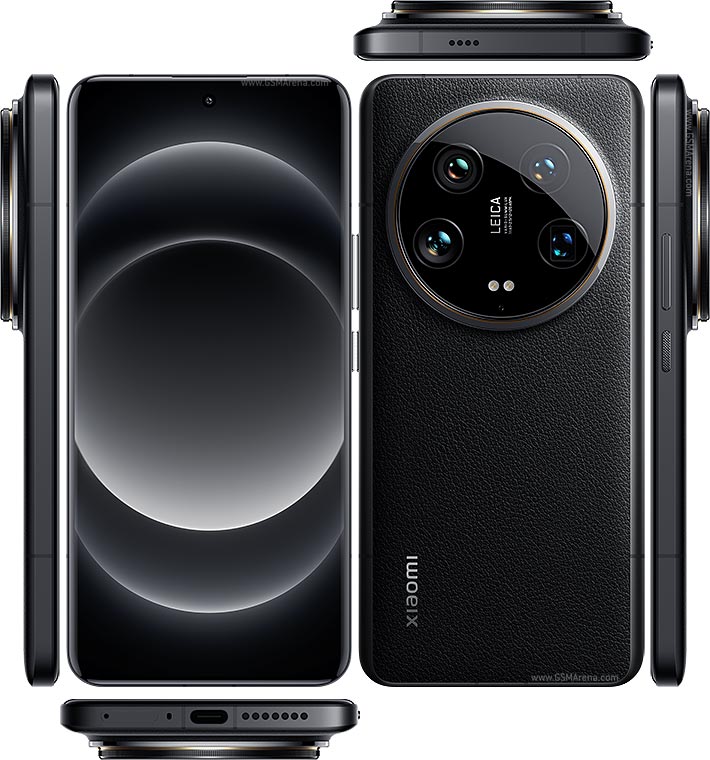
Photos via GSMArena · click to expand · ←/→ keys or swipe to navigate
Quick Specs
A photographer's flagship: a 1-inch variable-aperture main sensor, a 3.2x and 5x Leica zoom kit, and a 3000-nit screen on the Snapdragon 8 Gen 3.
Buy it for
Think twice if
Overall expert editorial score
| Release Date | February 22, 2024 |
|---|---|
| Market Status | Available |
| Announcement | February 2024 (global launch at MWC) |
| Dimensions | 161.4 x 75.3 x 9.2 mm |
|---|---|
| Weight | 219.8 g (glass) / 229.5 g (Titanium Special Edition) |
| Build | Xiaomi Shield Glass front, glass or eco-leather back, aluminum frame (titanium on the Special Edition) |
| IP Rating | IP68 (dust-tight, water-resistant to 1.5m for 30 min) |
| Colors | Black, White, Blue, Titanium (Special Edition) |
| Type | LTPO AMOLED, 68B colors, Dolby Vision, HDR10+, 1920Hz PWM dimming |
|---|---|
| Size | 6.73 inches |
| Resolution | 1440 x 3200 (1.5K), 522 ppi, 3000 nits peak |
| Aspect Ratio | 20:9 |
| Pixel Density | 522 ppi |
| Screen-to-Body Ratio | ~89.6% |
| Refresh Rate | 120Hz (LTPO adaptive 1-120Hz) |
| Peak Brightness | 3000 nits |
| Protection | Xiaomi Shield Glass |
| Notch | Centered punch-hole |
| Touchscreen | Capacitive, multi-touch |
| OS | Android 14, HyperOS (up to 4 major Android upgrades) |
|---|---|
| UI | HyperOS |
| Chipset | Qualcomm SM8650-AB Snapdragon 8 Gen 3 (4nm) |
| CPU | Octa-core (1x3.3GHz Cortex-X4 + 3x3.2GHz A720 + 2x3.0GHz A720 + 2x2.3GHz A520) |
| Fabrication | 4 nm (TSMC N4P) |
| GPU | Adreno 750 |
| Architecture | 64-bit |
| RAM | 12 GB / 16 GB (LPDDR5X) |
|---|---|
| Internal Storage | 256 GB / 512 GB / 1 TB (UFS 4.0) |
| Expandable Storage | No |
| USB OTG | Yes |
| Setup | Quad (Leica) |
|---|---|
| Primary | 50 MP, f/1.63-f/4.0 variable aperture, 23mm, 1-inch Sony LYT-900, OIS, Leica Vario-Summilux |
| Ultra-Wide | 50 MP, f/1.8, 12mm, 122 degrees, dual pixel PDAF |
| Macro | Via 3.2x telephoto (focuses from 10cm) |
| Flash | Dual-LED |
| Video | 8K@30fps, 4K@120fps Dolby Vision HDR 10-bit, gyro-EIS |
| Features | Leica optics, Laser AF, color spectrum sensor, TOF 3D depth, optional 67mm filter ring |
| Setup | Single (punch-hole) |
|---|---|
| Resolution | 32 MP, f/2.0, 22mm wide |
| Video | — |
| Capacity | 5000 mAh |
|---|---|
| Type | Li-Po, non-removable |
| Wired Charging | 90W wired HyperCharge (PD3.0, QC4, ~33 min) |
| Wireless Charging | 80W wireless (~46 min), 10W reverse wireless |
| Port | USB Type-C 3.2 Gen 2 |
| Network | GSM / HSPA / LTE / 5G |
|---|---|
| 5G | Yes, dual-mode SA/NSA (sub-6GHz) |
| SIM | Dual SIM (Nano-SIM, dual stand-by) |
| Wi-Fi | Wi-Fi 7 (802.11 be), tri-band |
| Bluetooth | 5.4, aptX HD, aptX Adaptive, LHDC |
| GPS | Dual-band GPS (L1+L5), GLONASS, BeiDou, Galileo, QZSS, NavIC |
| NFC | Yes |
| Infrared | Yes (IR Blaster) |
| USB | USB Type-C 3.2 Gen 2, DisplayPort, OTG |
| Loudspeaker | Yes, stereo speakers |
|---|---|
| 3.5mm Audio Jack | No |
| Audio Output | 24-bit/192kHz Hi-Res & Hi-Res Wireless audio |
| Fingerprint | Under-display (optical) |
|---|---|
| Face Unlock | Yes |
| Sensors | Accelerometer, gyroscope, proximity, compass, barometer |
| main_camera_periscope | 50 MP, f/2.5, 120mm (5x periscope), OIS |
|---|---|
| main_camera_telephoto | 50 MP, f/1.8, 75mm (3.2x floating), OIS, 10cm macro |
Configuration
Across 3 retailers · prices update frequently
Where to buy
Prices and stock are accurate as of the last update. TechSpecs may earn a commission on purchases made through these links, at no extra cost to you.
The Xiaomi 14 Ultra remains one of the best camera phones ever built. A 1-inch main sensor with a real f/1.63-f/4.0 variable aperture, twin Leica telephotos, a brilliant 3000-nit screen and the Snapdragon 8 Gen 3 make it a photographer's dream, and prices have fallen since launch. The catches: it's large and heavy, default processing can underexpose, and it now runs last-gen silicon - but for photography, few phones match it.
The variable aperture is the real deal
Being able to actually stop down to f/4.0 for landscapes and open to f/1.63 for portraits is something no other phone gives me. The 1-inch sensor pulls in incredible light and the 5x periscope is sharp. With the Photography Kit grip it genuinely feels like a compact camera. Best phone camera I've owned.
Incredible camera, but learn Pro mode
Out of the box it tends to underexpose and the colors can be flat - once I started shooting in Pro mode and editing a little, the results are stunning. It's also heavy with a big bump, so one-handed use is awkward. Worth it for the photos, but it's a committed photographer's phone.
Still fast, great value now
The Snapdragon 8 Gen 3 handles everything and the screen is gorgeous at 3000 nits. Now that prices have dropped it's a brilliant deal for the camera you get. HyperOS needed some cleanup of pre-installed apps, and I wish it had the newer chip, but for the money the camera alone makes it worth it.
Own this device? Share your experience.
Your overall rating
0 / 2000
Pick a star rating to continue.
Its 1-inch 50 MP main sensor (Sony LYT-900) has a stepless f/1.63-f/4.0 variable aperture - a real adjustable iris - paired with a Leica Vario-Summilux lens. It's part of a quad system with a 50 MP 3.2x floating telephoto, a 50 MP 5x periscope, and a 50 MP ultrawide.
The 4 nm Qualcomm Snapdragon 8 Gen 3 (SM8650-AB) with an Adreno 750 GPU, paired with up to 16 GB of LPDDR5X RAM and 1 TB of UFS 4.0 storage. Note this is the 2024 flagship chip, a generation behind the Xiaomi 15 Ultra's Snapdragon 8 Elite.
The global model has a 5000 mAh battery. It supports 90W wired HyperCharge (about 33 minutes to full), 80W wireless charging, and 10W reverse wireless charging.
Yes. It carries an IP68 rating, meaning it is dust-tight and water-resistant in up to 1.5 m of fresh water for 30 minutes. It is not built for swimming or saltwater.
The 14 Ultra (2024) uses the Snapdragon 8 Gen 3, a 3000-nit screen, and a 1-inch main with a variable f/1.63-f/4.0 aperture. The 15 Ultra (2025) upgrades to the Snapdragon 8 Elite, a brighter 3200-nit screen, a 200 MP periscope, and 90W wireless charging, but uses a fixed-aperture main.
No to both. There is no 3.5 mm headphone jack - audio is over USB-C or Bluetooth 5.4 - and storage is not expandable via microSD.
It launched globally at around $1,299 / EUR 1,499 for 16 GB + 512 GB and has since been largely discontinued. In Bangladesh it had no broad official launch; grey-market and used listings now run roughly BDT 1,22,000 to BDT 1,60,000 depending on condition and variant.
The Xiaomi 14 Ultra was the company's 2024 Leica camera flagship, and it remains one of the most serious photography phones ever made. Its centerpiece is a 1-inch 50 MP main sensor (Sony LYT-900) with a stepless f/1.63-f/4.0 variable aperture - a mechanical iris you can dial like a real camera - joined by a 3.2x floating telephoto and a 5x periscope to form a Leica quad. Around it sits a 6.73-inch 3000-nit LTPO AMOLED, the Snapdragon 8 Gen 3, and a 5000 mAh battery with 90W wired and 80W wireless charging.
This is a phone for photographers first. The variable aperture lets you genuinely control depth of field and exposure, the 1-inch sensor pulls in light most phones can't, and the twin telephotos cover everything from portraits to distant detail with Leica color science. It also appeals to anyone who wants a still-fast flagship at a now-reduced price, and who values the optional Photography Kit grip and 67 mm filter thread for a camera-like shooting experience.
Camera: a Leica quad led by a 1-inch 50 MP main with f/1.63-f/4.0 variable aperture, plus a 50 MP 3.2x floating telephoto, a 50 MP 5x periscope and a 50 MP ultrawide - all OIS where it counts.
Display: a 6.73-inch 1.5K LTPO AMOLED at 120 Hz, up to 3000 nits peak, with Dolby Vision and Xiaomi Shield Glass.
Performance: the 4 nm Snapdragon 8 Gen 3 with up to 16 GB LPDDR5X and 1 TB of UFS 4.0 storage.
Charging: a 5000 mAh battery with 90W wired (full in ~33 min), 80W wireless and 10W reverse wireless.
The camera ambition makes for a large, heavy device with a substantial bump that's awkward one-handed. Xiaomi's default processing tends to underexpose, so getting the best results often means shooting in Pro mode or editing afterwards. It now runs the previous-generation Snapdragon 8 Gen 3 rather than the 8 Elite, and as a 2024 flagship it has been largely discontinued, so most stock is grey-market or used. There's no headphone jack and no expandable storage.
The Xiaomi 14 Ultra is a photographer's phone with few equals - a true 1-inch sensor, a variable aperture, and a versatile Leica zoom kit - and at today's reduced prices it's a compelling buy if the camera is your priority. Just know you're working with last year's chip and a hefty body. Line it up against current flagships in our specs compare tool.
A photographer's flagship: a 1-inch variable-aperture main sensor, a 3.2x and 5x Leica zoom kit, and a 3000-nit screen on the Snapdragon 8 Gen 3.
Share quick feedback - it's anonymous and separate from comments.

Comments
No comments yet - be the first to share your thoughts.
Leave a comment